
Let’s be honest. Walking into a toy aisle—or scrolling through endless online listings—can feel overwhelming. Flashing lights, cartoon characters, and a symphony of electronic noises all scream for your child’s attention (and yours). It’s a sensory minefield designed to overstimulate. But what if playtime could be different? What if it could be quieter, more focused, and genuinely nourishing for your child’s developing mind? This is where the world of Montessori toys comes in, and it’s less about a specific brand and more about a philosophy you can bring home.
If you’ve heard the term but aren’t quite sure what makes a toy “Montessori,” you’re in the right place. This isn’t about strict rules or an expensive classroom setup. It’s about choosing simple, purposeful playthings that follow your child’s natural development, fostering independence, concentration, and a deep, lasting love for learning. Think less clutter, more engagement. Fewer batteries, more curiosity. Let’s explore how you can start this transformative journey.
What Makes a Toy “Montessori”? The Core Principles
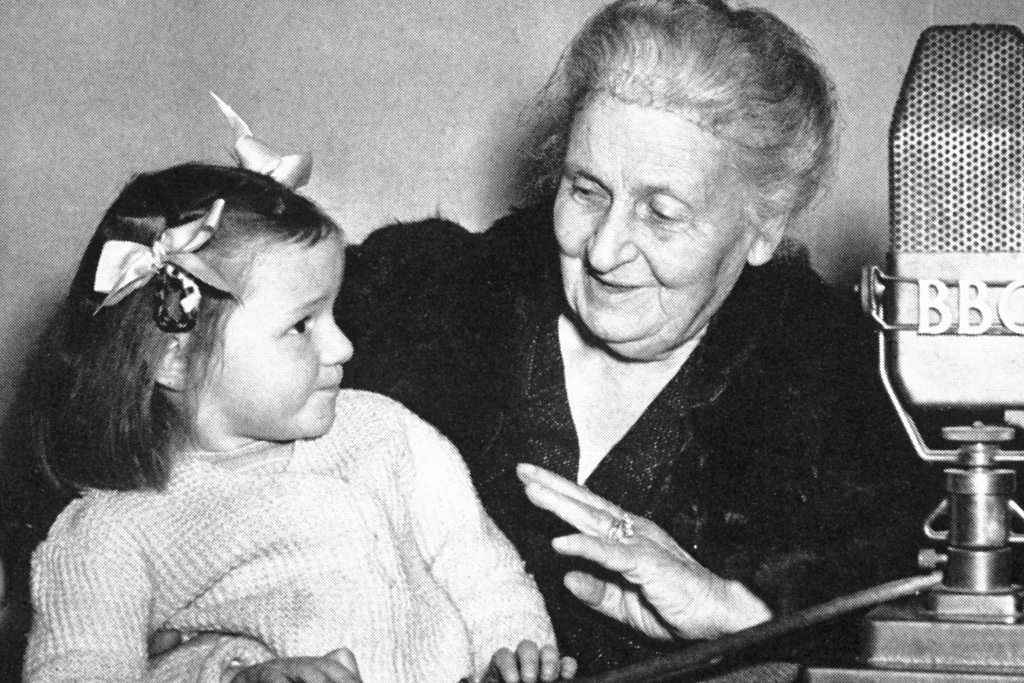
The Montessori method, developed by Dr. Maria Montessori over a century ago, observes that children learn best through direct, hands-on interaction with their environment. Montessori toys are the tools that facilitate this. They aren’t really “toys” in the traditional sense, but rather “materials” for self-directed exploration. To choose the right pieces for your home, look for these key characteristics:
1. Natural & Simple
In a world of plastic, Montessori materials stand out. You’ll often find wood, cotton, metal, or glass. Natural materials are not just aesthetically pleasing; they are beautiful, durable, and offer authentic sensory feedback. A wooden block has weight; a metal bowl feels cool to the touch; a cotton ball is light and soft. These textures offer real-world information that plastic cannot replicate. Furthermore, natural materials connect a child to the organic world, grounding their play in reality.
2. Purposeful & Self-Correcting
A great Montessori learning toy has a clear purpose and often contains a built-in “control of error.” This is perhaps the most magical part of the philosophy. It means the child can see for themselves if the piece fits, if the sequence is right, or if the match is correct, without an adult needing to intervene or say “no.” This builds independence and problem-solving skills. When the child discovers the solution themselves, it creates a powerful internal reward system that far outweighs external praise.
3. Isolation of Skill
Instead of a multi-function gadget that sings the ABCs, counts, and flashes colors all at once (which often leads to cognitive overload), a Montessori material focuses on one concept at a time. A wooden educational material might focus solely on differentiating sizes, or solely on matching colors. This isolation helps a child master one concept deeply and clearly without distraction, allowing their brain to categorize information more effectively.
4. Promotes Concentrated Work
These materials are designed to be used on a floor mat or at a small table, encouraging a child to focus on a single activity for an extended period. This deep concentration—what Dr. Montessori called the “flow state”—is where the magic of cognitive development happens. When a child is truly absorbed in a task, they are not just playing; they are building their neural pathways and learning how to learn.
Finding the Right Fit: Montessori Toys by Developmental Stage
While many Montessori toys grow with your child, their interests and capabilities evolve quickly. For the preschool age group (roughly 3-6 years old), children are in what Montessori called the “Absorbent Mind” phase. They are refining their senses, mastering movement, and laying the groundwork for math, language, and abstract thought. This is a prime time for materials that challenge their reasoning, fine motor skills, and sensory discrimination.
Phase 1: Building a Foundation (Sensory & Practical Life)
Long before letters and numbers, a child’s world is understood through their senses. Sensory Montessori toys help classify and order these impressions, which is a direct preparation for the intellect.
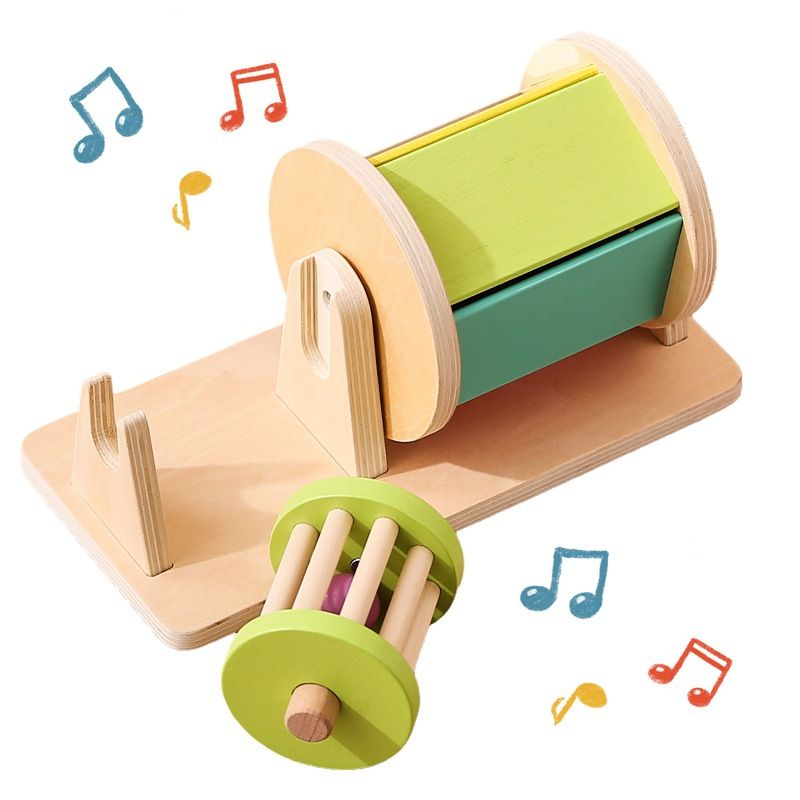
Consider the Montessori Fabric Drum. This isn’t just a noisemaker; it’s a tactile exploration station. Covered in varied fabrics—smooth satin, nubby linen, soft fleece, and rougher canvas—it invites a child to roll, touch, and compare. This quiet, focused activity sharpens their tactile perception and descriptive vocabulary. As they feel the difference between “smooth” and “rough,” they are laying a subtle foundation for future science and language learning. It’s a perfect example of a sensory teaching project that feels like pure play.
Practical life activities are equally crucial. In a Montessori home, we value tasks that involve transferring, sorting, and matching. These build the fine motor control needed for writing. Our Montessori Bead Matching Toy is a star here. Using a specially designed clip or wooden tongs, children pick up small beads and sort them by color into matching cups. This repetitive, satisfying work is a powerhouse for developing the pincer grip (the coordination of the thumb, index, and middle finger), directly strengthening the muscles needed for holding a pencil later on. It’s a learning toy for 4–6 year olds that turns a fundamental skill into a captivating, colorful game.
Phase 2: Mastering Dimensions (Visual Discrimination & Spatial Awareness)
As the child moves into the “conscious” stage of development, they become obsessed with order and size. This is where classic Montessori wooden materials truly shine. They turn abstract concepts like dimension, sequence, and geometry into physical objects a child can manipulate and “feel.”
The Cylinder Set is a quintessential piece. With blocks that vary in height, diameter, or both, a child must carefully observe and compare to fit each cylinder into its correct socket. There’s no guessing; if the child puts a thin cylinder into a wide hole, they will eventually find themselves with a thick cylinder and no place to put it. This “control of error” is phenomenal for developing visual discrimination of size—a crucial pre-mathematical skill—and the ability to concentrate on a detailed task.
Similarly, the Montessori Rod Set makes the concept of “long and short” utterly tangible. Through arranging the ten rods from longest to shortest, a child gains a physical, intuitive understanding of length and serial order. They aren’t just learning a word; they are feeling the weight and seeing the physical span of “longer” versus “shorter.” It’s a hands-on lesson in comparison and sequencing that is far more effective than any worksheet or digital app.
Phase 3: The Creative Challenge (Logic & Geometry)
And let’s not forget the timeless appeal of our Montessori Wooden Shape Stacking Toys. Available in fun, engaging themes like forest or outer space, they take the classic shape sorter to the next level. It’s not just about forcing a triangle into a triangle hole. It’s about balancing, stacking, and creating.
This playful challenge builds incredible hand-eye coordination, logical thinking, and spatial reasoning. A child has to figure out how to build a stable, balanced tower, which involves an early understanding of physics and gravity. It’s the kind of open-ended, DIY-available project that keeps a preschool child engaged for long, productive stretches, moving from simple stacking to complex architectural feats.
Early Cognition: Color, Order, & Logic
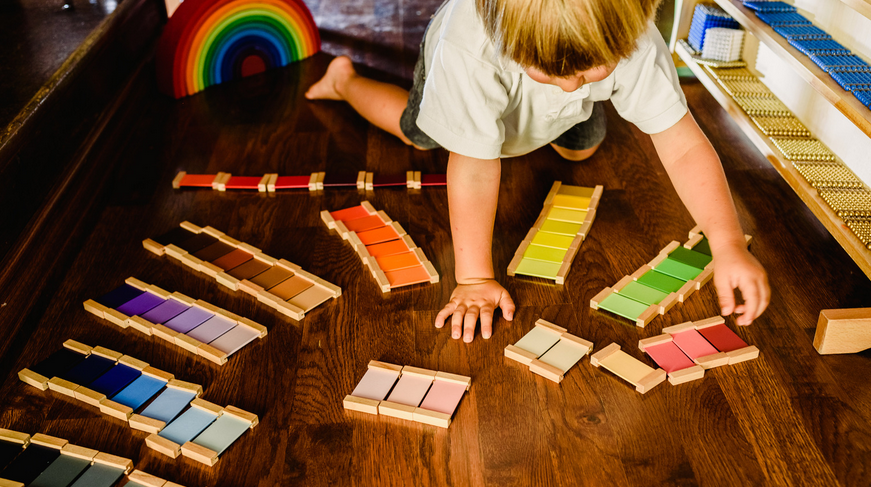
As sensory and spatial skills solidify, children naturally begin to classify and order their world by other attributes, like color. This is a critical step in cognitive development, moving the child from concrete objects to abstract categories.
Our Montessori Color Matching Learning Toy is designed precisely for this. Through the simple, satisfying act of pairing and grouping, children learn to observe subtle differences, create order out of chaos, and establish logical rules. Is this red the same as that red? Does this blue belong in this bowl? This focused activity is a direct workout for a young brain, enhancing both concentration and foundational cognitive abilities. It provides that “aha!” moment of self-correction that is so vital to the Montessori approach, fostering a sense of competence and pride.
Creating Your Montessori Space: The “Shelf” Mentality
You don’t need a dedicated classroom to bring Montessori home. You can transform any corner of your living room or bedroom with a few intentional changes. The key is Montessori toy storage that promotes order, accessibility, and choice.
1. Less is More (The Power of Rotation)
One of the biggest mistakes parents make is putting every toy the child owns out at once. This leads to “toy grazing”—where a child moves from one thing to another without ever deeply engaging. Instead, try a Montessori toy rotation. Choose 6-8 materials to display on a low, open shelf. Store the rest in a closet. When you notice your child has mastered a material or lost interest, swap it out for something “new” from your storage. This keeps the environment fresh and the child focused.
2. Display with Care
In a Montessori environment, we don’t use large toy boxes where everything is dumped in a heap. Instead, place each toy or material on a small tray or in a beautiful basket. The material should be “complete” and ready to use. This serves as a silent invitation to the child: “Come, work with me.” It also makes clean-up much more manageable, as the child knows exactly where each item belongs.
3. Follow the Child
The most important rule in Montessori is to “follow the child.” Observe them without interrupting. Are they seeking order by lining things up? Are they refining their movement by carrying heavy objects? Are they fascinated by how things fit together? Use these observations to guide which materials you put on the shelf next. When you match the material to the child’s “sensitive period,” their engagement will be effortless and profound.
4. Accessibility is Freedom
Ensure the shelves are at the child’s eye level and that they can reach everything safely. When a child can choose their own work and put it away independently, they develop a sense of agency and “I can do it” confidence that stays with them for life.
The Role of the Adult: From Teacher to Guide

In the Montessori approach, your role changes from an entertainer to an observer and a guide. This can be a huge relief for parents! You don’t have to “play” with your child every second. In fact, stepping back often allows them to discover more.
- Model, Don’t Lecture: If you introduce a new material, show them how to use it slowly and silently. Use your hands to demonstrate, not just your words. Children are master mimics; they will catch the “how-to” much better through your movements than through a long explanation.
- Respect the Concentration: If you see your child deeply focused on a task—even if they are doing it “wrong”—try not to interrupt. If they are happy and engaged, let them be. The process of discovery is more important than the “correct” result.
- Prepare the Environment, Not the Child: Focus your energy on making the space safe and inviting. Once the environment is right, the child’s natural curiosity will do the rest.
FAQ: Your Quick Montessori Questions, Answered
Q: Are Montessori toys only for kids in Montessori schools?
A: Absolutely not! The principles of respect for the child, independence, and hands-on learning are universal. Any child, regardless of their schooling, benefits from Montessori toys that encourage deep play and respect their developmental stage. You’re simply bringing thoughtful, proven educational principles into your home to support their natural growth.
Q: My child gets frustrated if they can’t do it right away. What should I do?
A: First, ensure the toy is age-appropriate. If it’s too hard, it’s okay to put it away for a few months. If they are just on the verge of mastering it, model the activity slowly and calmly once more, then step back. It’s okay for them to struggle briefly—that’s where problem-solving and resilience are built. If frustration mounts to distress, calmly suggest, “Let’s put this away for now and try again when our hands feel ready,” and move to a simpler task.
Q: These Montessori toys seem so simple. Won’t my child get bored?
A: This is the most common misconception! Simplicity is the genius of Montessori. A passive toy (like a plastic robot) that does everything for the child (lights up, moves, talks) becomes boring quickly because the child is just a spectator. An active material—an open-ended, challenging wooden tool—requires the child to act upon it. This offers endless opportunities for repetition, mastery, and creative variation. You’ll often find a child returning to the same wooden educational material for weeks, each time with greater skill and a new perspective.
Q: Are plastic toys “banned” in a Montessori home?
A: Not at all. Montessori is a philosophy, not a set of rigid laws. While natural materials are preferred for their sensory benefits and durability, many high-quality plastic toys can still align with Montessori principles if they are purposeful and promote independence. The goal is to be intentional about what you bring into your child’s space.
The Long-Term Impact: Beyond the Playroom

Building your child’s first collection of Montessori toys is more than just a shopping trip; it’s an investment in their character. By choosing quality over quantity, and purpose over distraction, you are teaching your child that their work is valuable. You are showing them that they are capable of solving problems, that they can concentrate on difficult tasks, and that learning is a joyful, self-directed journey.
Watching the profound satisfaction that comes from a child completing a bead-matching task or finally fitting that last cylinder into its hole is one of the greatest joys of parenting. It’s the spark of a “brighter mind” in action.
Ready to transform your home into a sanctuary of learning? Explore our carefully curated collection of authentic Montessori toys designed to engage, challenge, and grow with your preschooler. From the foundational Montessori Fabric Drum for sensory awakening to the cognitively rich Color Matching set for logical development, each piece is crafted with the wisdom of Dr. Montessori in mind.