
So, you’ve heard the buzz about Montessori toys. Maybe a friend raved about them, or you saw a beautifully curated, minimalist play space online. But when you start looking, the questions pile up faster than toy blocks on a floor: “Is this right for a 6-month-old?” “What should my two-year-old be working on?” “My preschooler seems bored with everything—help!”
You’re not alone. The world of Montessori parenting isn’t about buying a specific brand; it’s about understanding your child’s developing needs and offering the right tools at the right time. The beauty of these educational learning toys is that they meet children exactly where they are, turning everyday play into profound brain-building work.
This guide will walk you through the core Montessori principles for each stage, from curious infant to capable preschooler. We’ll translate the philosophy into practical choices, helping you build a thoughtful, engaging play environment that grows with your child. No jargon, just clarity.
Why Age Matters: The “Sensitive Periods” Secret
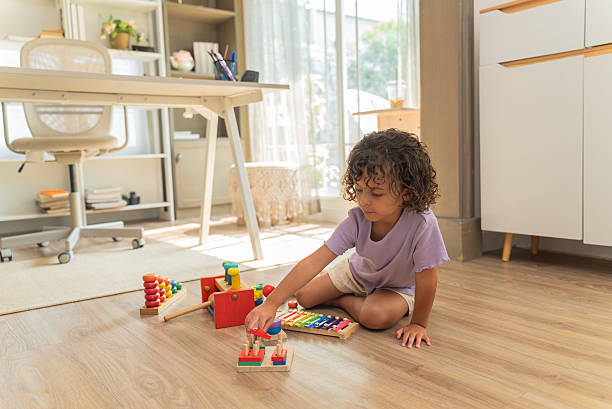
Before we dive into toy shelves, let’s crack the Montessori code. Dr. Maria Montessori identified “sensitive periods”—specific windows of time when a child’s brain is primed and eager to master a particular skill. It’s like their mind has a laser focus for language, or order, or movement.
Offering the right Montessori toys during these periods isn’t just helpful; it’s transformative. It feels effortless to the child and leads to deep concentration and mastery. Give a puzzle to a 6-month-old, and it’s a chew toy. Give it to a 3-year-old in their sensitive period for order, and they’ll work with intense focus until it’s complete. Our job is to spot the clues and provide the materials.
The Foundational Phase: Baby (0-12 months)
Forget flashy electronics. The best Montessori toys for infants are all about the real world. Your baby is a sensory explorer, using their mouth, hands, and eyes to understand their environment.
- Focus: Sensory stimulation, cause & effect, and gross motor development.
- Key Materials: Mobiles (especially high-contrast black & white), simple grasping toys, textured balls, wooden rattles, a floor mirror, and treasure baskets with safe household objects (a silicone spatula, a wooden spoon).
- The Adult’s Role: Create a safe “yes” space (like a floor mat) for free movement. Observe more, direct less. Watch what captivates them.
What You Won’t See Yet: The classic, more complex wooden educational materials. This stage is about laying the neural groundwork through simple, rich sensory experiences.
The Explorer Phase: Toddler (1-3 years)
Hold onto your hats! This is the age of movement, independence, and language explosion. Your toddler’s mission is to declare, “I can do it myself!” The best Montessori toys for toddlers support this fierce independence.
- Focus: Practical life skills, language, refined movement, and beginning of order.
- Key Materials: Simple puzzles with knobs, shape sorters, nesting cups, stacking rings, child-sized cleaning tools (dustpan, broom), dressing frames (for zippers and buttons), and books with real-life images.
- The Adult’s Role: Slow down. Break down activities (like pouring water or putting on shoes) into clear, slow steps. Offer limited, beautiful choices. Embrace the mantra: “Help me do it by myself.”
The Bridge to Preschool: Around 2.5 to 3 years, you might see the early signs of readiness for more advanced materials: longer attention spans, mastery of basic puzzles, and an interest in sorting or sequencing. This is your cue to start gently introducing the next level of Montessori learning toys.
The Big Leap: Preschool (3-6 Years) & Your Montessori Toolkit

Welcome to the sweet spot—the age where your child’s cognitive abilities blossom in incredible ways. This is the stage our curated collection of Montessori toys is specifically designed for. Their minds are moving from the concrete to the slightly abstract, and their hands are ready for precise, challenging work.
This isn’t about academic pressure. It’s about feeding their natural curiosity with the best wooden educational tools that turn abstract concepts into tangible, playable reality. Let’s look at the core developmental areas and the materials that bring them to life.
1. Refining the Senses: The Path to a Ordered Mind
Montessori believed that to understand the world, children must first classify their sensory impressions. Is it smooth or rough? Long or short? Loud or soft? This sensory order leads directly to intellectual order.
- The Material in Action: Our Montessori Fabric Drum is a masterpiece of tactile learning. It’s not a drum for banging; it’s a cylinder of discovery. Covered in patches of satin, burlap, corduroy, and fleece, it invites a child to roll, feel, and compare. This quiet, focused work of matching textures by touch is a direct training in focus and discrimination. It’s a sensory teaching project that builds the vocabulary and perception needed for future science and descriptive language.
2. Mastering Dimension & Spatial Awareness
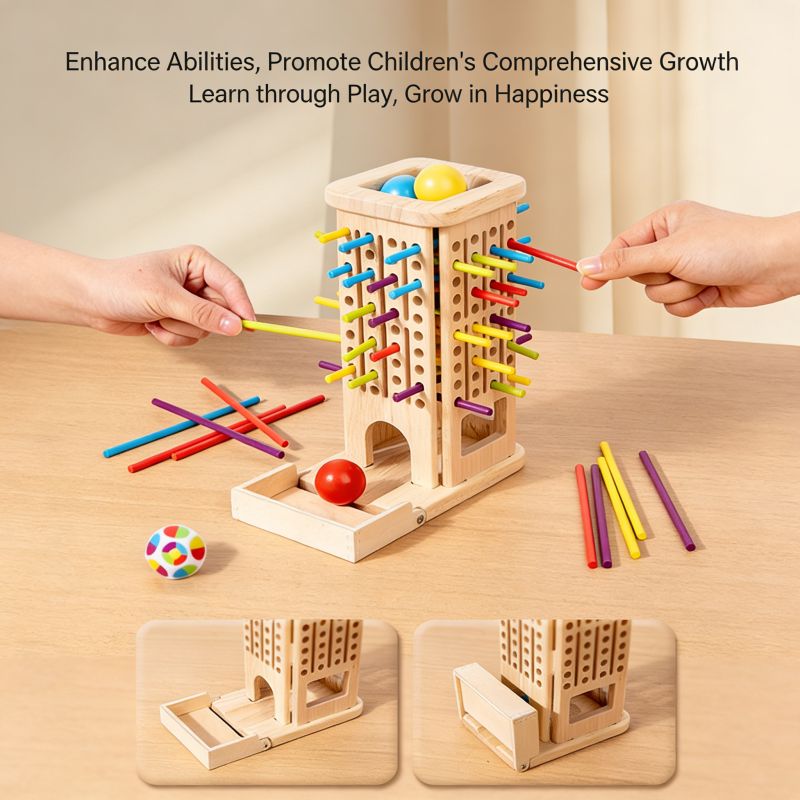
This is where classic Montessori materials truly shine, turning concepts like size, sequence, and geometry into physical objects a child can manipulate and, in doing so, internalize.
- Discriminating Size: The Montessori Cylinder Set is a quintessential material. With four distinct blocks, each containing ten cylinders that vary in height and/or diameter, the child has a very clear task: return every cylinder to its home. There’s no guessing—the cylinder only fits its perfectly matched socket. This work is phenomenal for developing visual discrimination of dimension, a critical pre-mathematical skill, and an almost meditative level of concentration.
- Understanding Sequence: The Montessori Rod Set (often called the Long Red Rods) makes the concept of “long and short” utterly concrete. Through the physical act of carrying and arranging the ten rods from longest to shortest, a child gains a muscular, intuitive understanding of length and serial order. It’s a hands-on lesson in comparison and sequencing that is far more effective than any worksheet. It’s a foundational teaching tool for 4–6-year-olds that builds logic through movement.
3. Building Fine Motor Skills & The “Pincer Grip”
The link between the hand and the brain is powerful in Montessori. Activities that refine the small muscles of the hand (fine motor skills) directly prepare for writing and foster independence.
- The Ultimate Pincer Prep: Look no further than our Montessori Bead Matching Toy. This isn’t just a color game. It’s a targeted workout for the “writing muscles.” Using a specially designed wooden clip, children pick up small beads and sort them by color into corresponding wells. This repetitive, satisfying action is meticulously designed to strengthen the pincer grip—the coordinated hold between the thumb, index, and middle finger. It’s a learning toy that discreetly lays the physical foundation for holding a pencil with control.
- Coordination & Problem-Solving: Our Montessori Wooden Shape Stacking Toys take the classic activity to a new level. With fun themes like forest or outer space, it’s more than just fitting a shape into a hole. It’s about balance, architecture, and gravity. Can they stack the crescent moon on top of the rocket? How high can their tower go before it tips? This playful challenge builds incredible hand-eye coordination, spatial reasoning, and logical thinking as they engineer their own creations. It’s open-ended, with DIY available for the potential for endless projects.
4. Early Cognition: Classification, Order & Logic
As their senses are refined, preschoolers naturally begin to classify the world by other attributes, like color. This act of sorting and matching is a cornerstone of early mathematical thinking.
- The Logic of Color: Our Montessori Color Matching Learning Toy is precision-built for this cognitive leap. Through the simple, satisfying act of pairing and grouping, children learn to observe subtle differences, create order, and establish logical rules. Where does this shade belong? This focused activity is a direct workout for a young brain, enhancing both deep concentration and foundational cognitive abilities. It provides that intrinsic “aha!” moment of self-correction that is so vital to independent learning.
Setting the Stage: The Montessori “Shelf” at Home
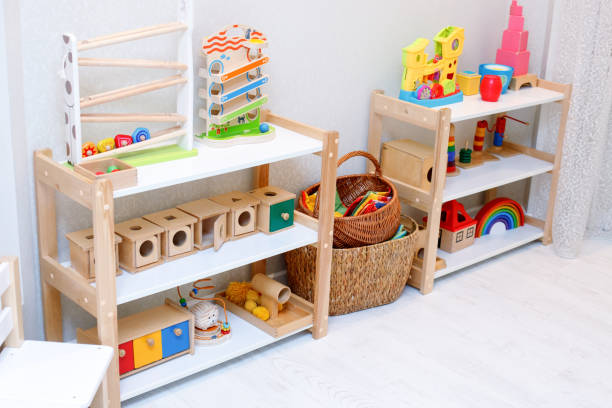
You don’t need a classroom. The magic happens with a simple, low shelf and the philosophy of rotation. This is key to Montessori toy storage that promotes engagement.
- Curate, Don’t Cram: Place 8-10 materials on a low, accessible shelf. Each item should be complete, on a tray or in a basket, and ready for use. This invitation to order is part of the learning.
- Follow Your Child: Watch what they gravitate toward. Are they seeking order? Give them more sequencing work. Craving tactile input? The Fabric Drum is perfect. Your observation is your best guide.
- Embrace the Work Cycle: A child chooses an activity, uses it for as long as they are focused (sometimes a surprisingly long time!), returns it to its place, and then chooses another. This cycle of choice, deep engagement, and responsibility is the heartbeat of Montessori at home.
FAQ: Your Montessori Age Questions, Answered
Q: My child is 4, but we’re just starting with Montessori. Are we too late?
A: Not at all! While starting early is wonderful, the principles are universally beneficial. A 4-year-old will often dive into materials like the Cylinder Set or Rods with incredible gusto, rapidly mastering them. The key is to start with simpler, purposeful activities (like pouring or transferring) to build concentration first, then introduce the more complex materials. Follow their interest—it’s your best compass.
thinker, andQ: Are these Montessori toys boring? They don’t light up or sing.
A: This is the most common misconception! A toy that does everything for the child is passive entertainment; it’s boring once the novelty wears off. A Montessori toy, like the Bead Matching set, is an object of activity. The child is the driver, the thinker, the problem-solver. The deep satisfaction comes from their own effort and mastery, which is inherently engaging and repeatable. The lack of bells and whistles is what allows their own cognitive bells to ring.
Q: How many Montessori toys should I have out at once?
A: Less is unequivocally more. A crowded shelf is overwhelming and leads to superficial play. For a preschooler, 8-12 available activities on a shelf is a great range. Rotate items every week or two based on what you see your child mastering or ignoring. A fresh material appearing on the shelf is an event in itself!
Navigating the world of Montessori toys by age is about becoming a thoughtful observer of your child’s unique journey. From the sensory wonders of babyhood to the complex, satisfying challenges of the preschool years, the right materials can transform play into a powerful engine for growth, independence, and confidence.
Our curated collection focuses on this pivotal preschool stage (ages 4-6), offering authentic, wooden educational tools designed to meet your child’s developing mind. Each piece—from the foundational Montessori Fabric Drum to the cognitively rich Color Matching Learning Toy—is crafted to be beautiful, purposeful, and to deliver that profound “I did it!” moment.
Ready to choose the right tools for your preschooler’s sensitive periods? Find the perfect Montessori learning toy to match your child’s developmental stage and spark independent play.