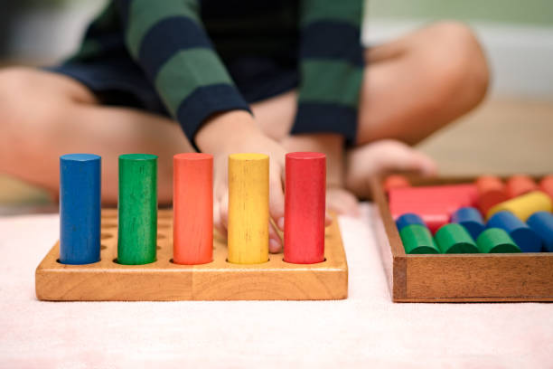
Every morning, I watch my five-year-old daughter hold a smooth wooden cylinder with near-reverent focus, her eyes fixed on the holes in the base, little brows furrowed in concentration. A few minutes later, I see her five-year-old cousin slumped on the sofa, thumbs rapidly swiping on a tablet, colorful blocks exploding on the screen, his gaze vacant and passive.
Two children of the same age, two radically different “play” experiences. This prompted me to ask: in this digital flood sweeping everything, are the “toys” we give our children building their brains, or hijacking them?
Increasing evidence from neuroscience and developmental psychology reveals that for 4-6-year-olds in the golden period of brain plasticity, physical, multi-sensory toys and virtual, 2D apps shape neural pathways in profoundly different ways. Today, I want to explore why seemingly “traditional” Montessori toys are not outdated but a crucial “remedy” for constructing healthy, balanced, and strong brains in the screen era.
Flickering Pixels vs. Tangible Reality: The Neurological Activation Difference
When children swipe on a smooth screen, a colorful game app delivers instant, exaggerated feedback: fireworks, coins, and cheerful music. The brain’s reward centers are rapidly stimulated, releasing dopamine—the “pleasure chemical.” But this is a passive, reflexive pleasure. The child triggers, and the program performs.
Now, consider a child with a Montessori cylinder set: ten solid wooden cylinders and matching holes, no sounds, and no flashing lights.
When the child picks up a cylinder, their brain engages in a complex, multi-layered symphony:
- Tactile cortex: fingertips sense wood’s temperature, weight, and smooth surface.
- Visual cortex: compares cylinder diameter with hole size, assessing 3D space.
- Motor cortex: guides hand muscles, adjusting angle and force to fit the cylinder.
- Prefrontal cortex: plans new strategies if the cylinder doesn’t fit—“Try another hole?” or “Rotate it?”
- Cerebellum: coordinates balance and fine motor control.
Most importantly, when the cylinder finally “clicks” perfectly into place, the child experiences achievement from influencing the physical world with their own ability. This pleasure is intrinsic and deep and cultivates a positive neural cycle of effort → challenge → success, nurturing self-efficacy.
Screen apps provide external, immediate, consumptive pleasure; physical Montessori toys provide internal, delayed, constructive joy. The former is like fast food—quick but empty; the latter, a nourishing meal—supporting long-term brain development.
The Brain Needs Sensory Integration, Not Information Overload
Humans, especially children, learn about the world through their senses. Our brains evolved not to process abstract, 2D symbols but to integrate rich inputs from vision, touch, hearing, smell, and proprioception to build reliable, three-dimensional mental models.
This is a cornerstone of Montessori education: sensory training. Physical Montessori toys are perfect arenas for sensory integration.
Take the cylinder set—it is more than a “shape-matching” toy. It is a multi-sensory mini-laboratory:
- Visual-proprioceptive integration: eyes guide hands to specific positions.
- Tactile-visual integration: fingers feel cylinder width, matching what eyes see.
- Proprioception (spatial awareness): The child senses arm and wrist position in 3D space.
- Weight and texture perception: solid wood provides feedback no screen simulation can replicate.
Every successful placement strengthens cross-sensory neural connections, laying the physical foundation for complex learning—reading, writing, and math. A brain accustomed to multi-dimensional sensory integration becomes flexible, resilient, and creative.
In contrast, most educational apps rely heavily on just visual and auditory channels. Children passively consume flattened, highly processed stimuli, missing opportunities for tactile, weight, and depth perception integration. Over time, this can create “sensory imbalance” and affect hand-eye coordination and spatial cognition.
Deep Focus vs. Fragmented Attention: Two Attention Patterns
Have you noticed children can sit with tablets for long periods, yet it’s more of a trance-like absorption? When they manipulate physical Montessori toys, their expression is calm and engaged.
Two distinct attention patterns emerge:
- App-driven attention: passive, stimulus-driven, and fragmented. Rapid screen changes and rewards train the brain to react to novelty, not sustain focused thinking. Like adult multitasking, it reduces concentration depth and quality.
- Physical toy-driven attention: active, goal-oriented, deep focus. The child sets objectives (complete matching), chooses strategies, and adjusts based on material feedback. This uninterrupted, linear thought process triggers flow, the foundation of real learning, creativity, and satisfaction.
In Montessori classrooms, children can engage with one material for 20–30 minutes, fully immersed. This deep focus, cultivated through appropriate physical materials, benefits them for life.
Case Study: Multi-Dimensional Brain Building with a Cylinder
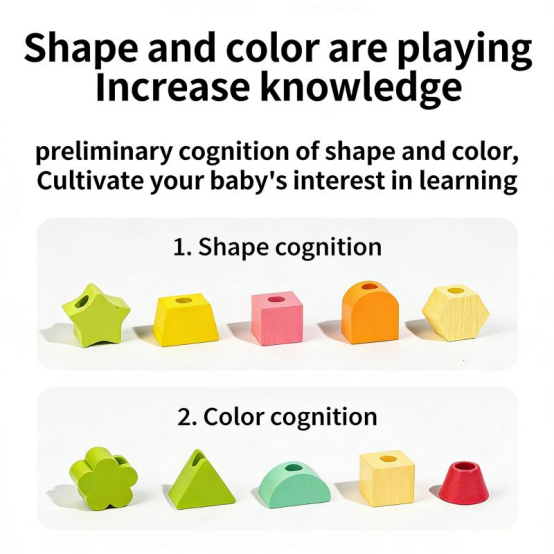
Observe a 4-year-old using a Montessori cylinder set:
| Stage | Activity | Neural & Developmental Focus |
| Observation & Planning | Scans cylinders and holes; devises rough strategy (start with thickest/thinnest) | Executive function, visual discrimination |
| Manipulation & Feedback | Picks cylinder, aligns with hole, senses resistance | Tactile development, hand-eye coordination, error detection |
| Adjustment & Problem-Solving | Rotates cylinder, tries other holes, compares visually | Logical thinking, problem-solving, persistence |
| Success & Integration | The cylinder fits perfectly, producing satisfying click | Memory formation, achievement, sensory integration |
This loop repeats for all ten cylinders. Neural connections strengthen naturally. No instructions, no “good job” rewards. Motivation and satisfaction come from direct interaction with reality.
In contrast, tablet shape-matching games provide instant, flashy rewards, stripping away weight, resistance, 3D space, and tactile feedback. The brain learns to expect external rewards rather than enjoy intrinsic problem-solving.
Balancing Digital and Physical Toys
Q: Complete screen prohibition is unrealistic. How to balance digital and physical Montessori toys?
A: The key is prioritization. Treat high-quality physical, multi-sensory play as the “main course,” and digital entertainment (even educational apps) as occasional “dessert” or “seasoning.” Set clear, limited screen time for 4–6-year-olds (e.g., 20–30 minutes/day) and ensure ample opportunity for engaging with hands-on Montessori toys in a screen-free “work corner.”
Q: Well-designed apps claim Montessori principles. Do they have value?
A: They can supplement learning, e.g., illustrating dynamic processes or language exercises. But they cannot replace the core value of 3D physical manipulation. Apps cannot provide real gravity, resistance, or tactile warmth, nor develop fine motor skills and hand-eye coordination essential for future writing, movement, and self-care. Relying solely on apps may create an illusion of learning; real Montessori learning combines hands, brain, and tangible materials.
Conclusion: Choosing Real “Nutrition” for the Brain
We live in a digital era; this is unavoidable. All the more reason to provide developing, plastic brains with the essential “nutrition” they truly need.
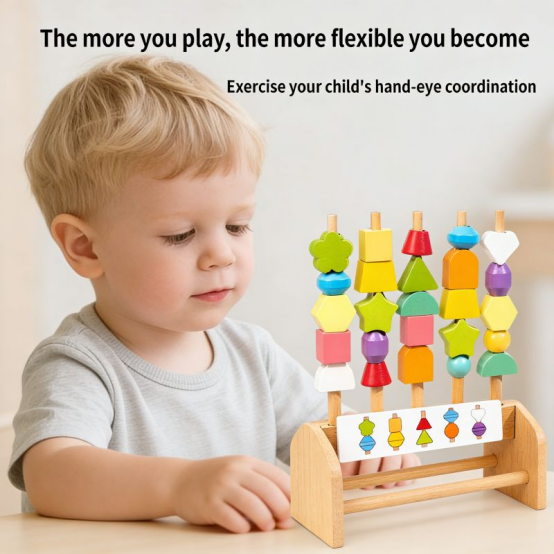
Choosing Montessori toys supports natural, healthy brain development. You’re not selecting simple entertainment but a neurodevelopmental tool. Through purposeful, multi-sensory, self-correcting physical interaction, children build:
- Strong sensory integration networks
- Deep focus and problem-solving skills
- An internalized understanding of the physical world
- Intrinsic motivation independent of external rewards
Classic tools like the Montessori cylinder set represent a return to essential educational wisdom. Beyond the blue light of screens, they provide a space where hands, eyes, and brains work in harmony, growing quietly and steadily.
In a world full of virtual stimuli, this tangible, weighted gift may be the most solid foundation a child’s brain needs. Start with a simple wooden Montessori toy, and lay the groundwork for a healthy, resilient mind.