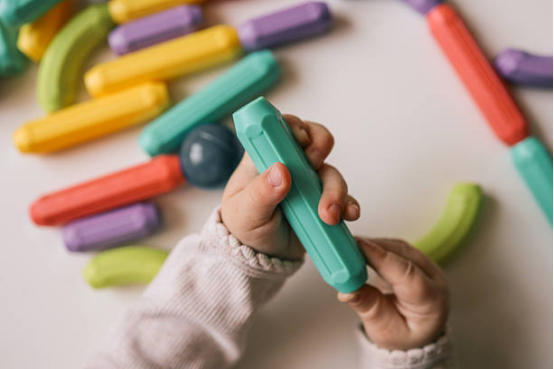
Have you fallen into this parenting trap? Watching those flashy, noisy, multifunctional electronic toys in stores, we often think they are better at “developing intelligence.” Subconsciously, we believe that the more complex and “smart” the toy, the smarter the child.
Today, I invite you to shift your perspective. Let’s temporarily put aside the noisy technology and return to a quiet, simple wooden toy—like a classic Montessori cylinder block—and consider a disruptive question: when the toy “does everything” for the child, what does the child’s brain have left to do?
The answer may surprise you: the seemingly simplest and “quietest” Montessori toys often contain the deepest learning power.
What Happens When the Toy “Thinks” for the Child?
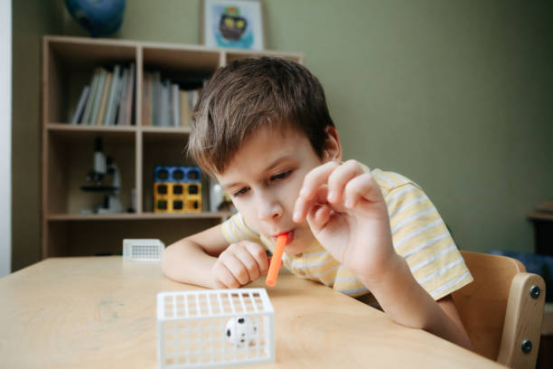
Imagine a typical light-and-sound electronic toy: the child presses a button, and the toy responds immediately with music, lights, and automatic actions. This process seems interactive but is actually passive. The child’s role is more like a “trigger,” while the toy is the main performer. The brain only needs to issue a simple command and then enters watching mode.
Over time, children may become accustomed to instant, intense sensory feedback, losing precious opportunities to observe in silence, reason through trial and error, and persist through challenges. Their attention fragments, waiting for external entertainment rather than being driven by internal exploration.
This is exactly what the Montessori educational philosophy warns against.
Montessori’s “Simplicity” Philosophy: Paving the Way for Independent Exploration
One of Dr. Maria Montessori’s core observations is that children are natural learners, building themselves through direct interaction with the real environment. Therefore, true educational tools should not perform but act as silent mentors.
This is the essence of “simple” design. It is not about saving money or being lazy but a deliberate educational strategy, reflected in two key principles:
- Isolating the challenge: A good Montessori toy usually focuses on a single learning goal. For example, a toy set may concentrate only on “size discrimination” without mixing in colors or patterns. This isolation allows children to clearly focus on the challenge at hand without being distracted by extraneous information.
- Built-in error control: This is the most ingenious part of simple design. True Montessori materials do not require constant parental corrections. The toy itself allows the child to discover and correct errors. When the last cylinder does not fit into the remaining hole, the child realizes a mismatch and actively rechecks and adjusts.
This design fully returns the learning initiative to the child. They are no longer passive recipients waiting for the correct answer but active problem solvers.
A Classic Case: The Secret of the Cylinder Block
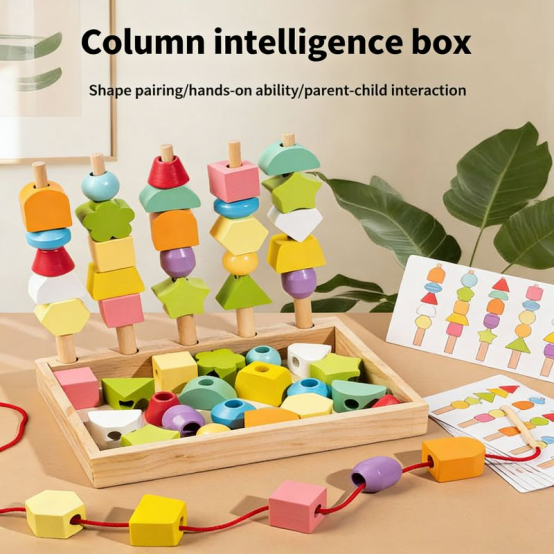
Take the classic Montessori cylinder set as an example. Place it between you and your child, and observe this “silent dialogue.”
At first glance, you may only see a wooden block with ten circular holes and ten cylinders of varying sizes. Nothing more. No instructions, no right-or-wrong sounds.
But when a 4–6-year-old begins to work, a complex brainstorm quietly unfolds:
- Eyes at work: Scanning cylinders and holes, visually comparing: Which is the thickest? Which is the longest?
- Hands at work: grasping a cylinder with three fingers, feeling its weight and volume. Fingertips touch the smooth wooden surface, sending tactile information to the brain.
- Brain connecting the dots: Combining visual and tactile information to make an initial guess: “This might go into that hole.” Attempting placement.
- Error control intervenes: if the cylinder is too thin, it falls through the hole. If too thick, it cannot fit. Each outcome is a physical reality giving direct feedback without the toy saying “wrong.”
- Prefrontal cortex adjusting strategies: The child removes, reobserves, compares, hypothesizes, and tries again, possibly repeating the process multiple times.
Ultimately, when all cylinders fit perfectly, forming a smooth surface, the child experiences a complete sense of achievement from the inside out. They conquer not just a toy but a real problem through observation, persistence, and intelligence.
This seemingly simple process systematically develops visual discrimination, hand-eye coordination, focus, sense of order, and logical thinking. More importantly, it builds an “I can do it” mindset—an integrated learning experience no button-pressing toy can ever offer.
How to Choose “Effective” Simple Toys for Children
Understanding the principles behind them helps us cut through marketing fog and make wiser choices. Next time you select Montessori or any educational toy, ask yourself:
| Question | Reason |
| Is it made of natural, real materials? (Wood, cotton, metal) | These materials provide rich sensory feedback; weight, temperature, and texture vary—unmatched by plastic. |
| Does it have a clear, isolated goal? | Can the child immediately see whether the toy is about “matching,” “sorting,” or “building”? Avoid complex hybrids claiming to develop ten skills at once. |
| Does it allow and encourage self-correction? | Can the child independently discover whether they did it right? This is key to authentic Montessori materials. |
| Is it aesthetically pleasing and orderly? | Montessori emphasizes the beauty of the environment. Well-designed toys invite respectful, focused work. |
Common Questions You May Have
Q: The Montessori toy is so simple; won’t my child get bored quickly?
A: This is the fascinating part. True “simple” Montessori toys have astonishing repeat exploration value. A child may focus on placing cylinders today, attempt blindfolded pairing later, or use cylinders for storytelling and naming over time. The toy doesn’t change, but challenges evolve with the child’s cognitive development. This “ever-fresh” characteristic is missing in cheap imitations and complex electronic toys.
Q: Do I need to guide my child while playing?
A: The best role is a “prepared environment guide” and silent observer. You can demonstrate once slowly and clearly, then step back. Unless the child is extremely frustrated, avoid corrections or prompts. Allow mistakes; discovering errors and adjusting strategies is the core of learning. Your trust and patience are the greatest respect for a child’s independent thinking.
Conclusion
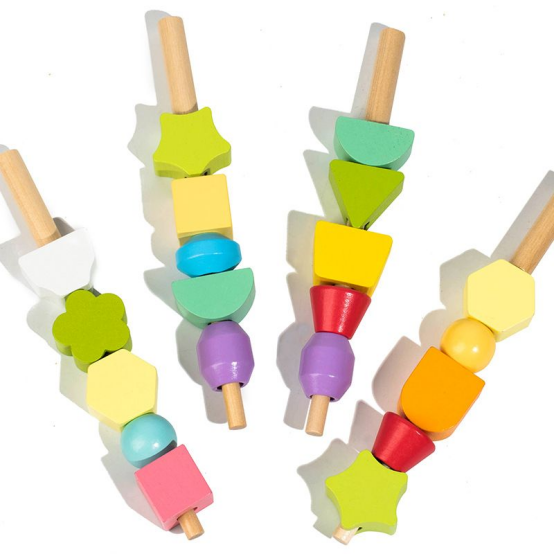
In an era chasing more, faster, and louder, choosing “less” and “slower” for children requires greater wisdom and courage. The beauty of Montessori toys lies not in what they are, but in what they are not: they are not light-and-sound bombardments, not showcases of adult intelligence, nor entertainment for passive consumption.
They are silent bridges connecting a child’s curious mind with the physical laws of the real world. They offer not answers but the path to discovering answers.
If you want your child to experience this inward-outward learning joy and the flow of deep focus, starting with a classic, back-to-basics toy like the Montessori cylinder set may be the perfect choice. It will not educate your child for you, but it will demonstrate the power of innate learning when the child is given trust and proper tools.
Start simple, reach profound. This is the timeless wisdom Montessori leaves us.