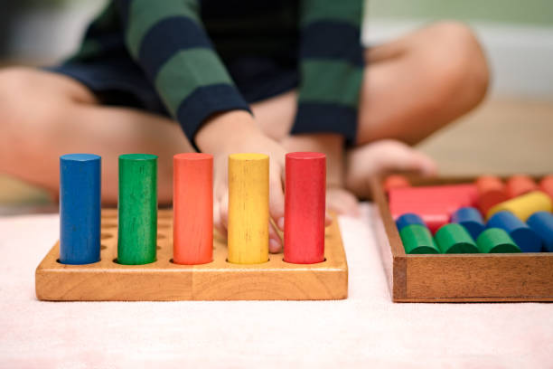
Have you ever had this experience: excitedly buying a toy labeled “Montessori,” only to find your child abandons it after two minutes, or noticing it looks no different from a standard educational toy? Today, the “Montessori” concept is everywhere—from low-cost wooden toys to high-end subscription boxes. But what exactly is a Montessori toy with an educational soul?
Selecting genuine Montessori materials isn’t about reading labels; it’s about understanding the design philosophy behind them. Today, we move past the marketing hype to deconstruct the five core design principles. Mastering these will help you distinguish between “tools” that promote deep work and mere “decorations.”
Principle 1: The Goal is “Self-Construction,” Not “Entertainment”

The core purpose of ordinary toys is to entertain. In contrast, true Montessori materials are “work materials” for the child, designed for internal self-construction. They do not rely on lights or sounds to attract a child but spark intrinsic exploration through appropriate challenges.
The joy of success does not come from reward sound effects but from the inner sense of achievement: “I did it!”
For example, a classic Montessori color bead matching toy doesn’t sing. Its attraction lies in a clear task: using tongs to categorize colors. The child must mobilize observation, fine motor skills, and patience. This satisfaction from overcoming challenges is the true driver of sustained concentration.
Principle 2: The Wisdom of “Control of Error”
This is one of the most ingenious designs in Montessori education. “Control of Error” means the material provides feedback, allowing the child to discover and correct mistakes without adult intervention. This fosters independent problem-solving and critical thinking.
- Visual Feedback: In cylinder block games, if a cylinder is misplaced, it will either stick out or be too deep.
- Tactile Feedback: The disharmony naturally prompts the child that “something is wrong.”
- Role of the Adult: The parent remains a quiet observer while the child adjusts until perfection is achieved.
Principle 3: Minimalist Design Emphasizing “Isolation”
Dr. Montessori believed cluttered colors and functions distract children. Therefore, genuine materials are usually simple, using solid colors (like the pink of the Pink Tower) to isolate a single difficulty or concept at a time.
In the color bead matching toy, the shape and size are identical; the only variable is “color.” This eliminates distractions, allowing the child to focus entirely on one cognitive challenge. This “polished lens” for the senses leads to more profound learning.
Principle 4: “Realism” Tailored for a Child’s Hands
Montessori education views children as capable learners. Materials are designed with specific weights and sizes to fit a child’s ability—not as “miniature” versions of adult tools, but as functional materials to experience physical properties.
|
Feature |
Montessori Material Attributes |
|---|---|
|
Materials | Natural: Wood, metal, glass, ceramic, and cotton. |
|
Sensory Experience |
Warmth of wood, smoothness of glass, softness of cotton. |
|
Functionality |
Requires authentic effort (e.g., the real force needed to open tongs). |
Principle 5: From “Disordered Play” to “Ordered Work”
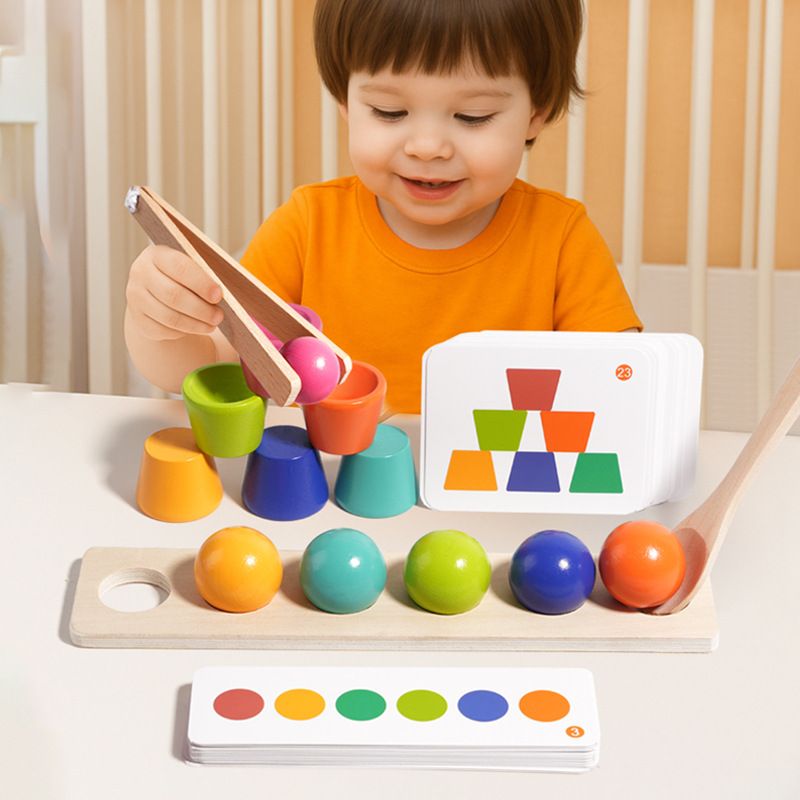
While ordinary play is often random, Montessori materials contain an inherent logical sequence. A complete cycle of work includes a clear beginning, process, and restoration.
When using the bead-matching Montessori toy, the child follows a cycle of order:
- Remove all beads.
- Pick them up one by one with tongs.
- Place them in the correct position after identification.
- Return everything to its place for the next use.
This develops a child’s sense of responsibility and work habits that last a lifetime.
As safety standards for children’s products continue to rise in 2025, prioritizing materials with exquisite craftsmanship and smooth edges is not just a safety baseline but a fundamental respect for the “designed for children” philosophy.
[Discover Authentic Montessori Tools for Your Home]
Frequently Asked Questions (FAQ)
Q1: Is it necessary to buy Montessori toys if I already have blocks and puzzles?
It depends on your goals. Blocks are great for creative imagination. However, Montessori materials are “specialized training tools” designed to develop specific abilities (fine motor, sensory logic) through self-education. They are highly valuable supplements.
Q2: Should I correct my child if they make a mistake?
Please restrain the urge to correct! Errors are an indispensable part of the learning process. The “control of error” feature allows the child to see the mismatch themselves. Your intervention interrupts their observation. Only guide through demonstration—not lecturing—if they are truly stuck.
Conclusion: Choosing Montessori Toys is Choosing Education
Selecting a genuine Montessori toy is a reflection of your understanding of how children learn. You aren’t just buying a plaything; you are choosing a silent, professional “tutor” that guides a child toward independence and confidence.
When you see a child focused on matching beads with a calm and satisfied expression, you realize you’ve provided more than a toy—you’ve provided a prepared environment for self-construction. This investment will return in the form of the child’s methodical behavior and passion for deep inquiry.