Have you noticed that the little one at home, just over four years old, seems to have suddenly “opened up”?
They no longer just throw toys around; they start lining up stuffed animals from big to small. They point at two piles of blocks and confidently tell you which side has “more.” They endlessly ask “why” and are especially persistent about the sequence of events—“I take a bath first, then we read a story, then sleep, right, Mom?”
If you observe these signs, congratulations: you are witnessing a miracle. Your child has entered a golden period of logical thinking.
Ages 4 to 6 mark a critical crossroads in cognitive development. Their brains are busy forming connections, trying to impose order, rules, and cause-and-effect on the chaotic sensory world. They are no longer satisfied with “what is”; they are eager to know “why” and “how.”
As parents, how can we support this natural thirst for knowledge? The answer isn’t in teaching formulas or flashcards early but in providing the right “thinking scaffolds”—and some ingeniously designed Montessori toys are excellent tools for building this initial thinking framework.
Why Ages 4–6? Understanding the Eve of “Concrete Operations”

According to developmental psychologists, children aged 4–6 are transitioning from the “preoperational stage” to the “concrete operational stage.” Sounds academic? Simply put:
- They begin mental operations but need concrete, tangible objects.
- They understand conservation: gradually realizing that stretching a piece of clay does not change its total amount.
- They are obsessed with classification, sorting, and pairing: an external manifestation of their inner drive to organize the world.
- The germ of reversible logic: beginning to understand that things can happen forward or backward.
At this stage, abstract numbers or symbols (like “5>3”) are still hollow to them. But they can fully grasp that this red rod in hand is “longer” than that short blue rod. These tangible, hands-on comparisons are the true nourishment for their logical growth.
From Chaos to Order: How Montessori Toys Serve as “Thinking Scaffolds”
The genius of Montessori education is that it perfectly aligns with children’s developmental needs at this stage. It doesn’t just talk about logic; it materializes abstract mathematical and logical concepts into manipulable, observable materials.
These Montessori toys act as scaffolds for thinking, allowing children to climb step by step, extracting logical rules from concrete experiences.
The core of this process is comparison, sorting, correspondence, and pattern discovery. Repeated practice in these operations unconsciously trains the core skills needed for future math, science, and all systematic thinking: observing differences, identifying patterns, forming hypotheses, and verifying results.
Core Recommendation: Let “Length” Speak for Itself

Among the many classic Montessori materials, one stands out as the “logic sequencing” mentor: the Montessori Rod Set.
Imagine this Montessori toy: ten solid wooden rods of the same width and color, varying only in length. They increase incrementally (each rod is 10 cm longer than the previous). Scattered on a mat, they may look like ordinary blocks, but to a 4–6-year-old, they are a puzzle, an order waiting to be restored.
Here’s how the child engages:
- Visual comparison and perception: Eyes scanning rods, brain estimating lengths quickly: “This looks the longest; that might be the shortest.”
- Hands-on manipulation and verification: picking up rods, moving them across the mat, and feeling differences—weight, balance, and grip required.
- Sorting and self-correction: Placing the rod deemed longest, then searching for the next. Errors are inevitable; the fifth rod may be mistaken for the fourth. As the next rod is placed, discrepancies appear—“dips” or “peaks”—prompting self-correction.
- Pattern formation and internalization: Through repeated adjustments, all ten rods eventually form a perfect “staircase” or “rainbow.” The child walks the sequence from shortest to longest, internalizing the incremental pattern.
At this moment, magic happens. Concepts like “length difference,” “sequence relationship,” and “incremental pattern” are absorbed through eyes, hands, and body, without verbal instruction. The child constructs a visual, tactile sequence.
This is more than playing; it lays a robust foundation for future math learning.
- Prepares for numbers: Each rod represents a tangible “quantity,” making abstract numbers concrete.
- Introduces measurement: Children intuitively grasp comparison and units.
- Fosters disciplined thinking: Tasks must start and end correctly, sequences must be accurate, and results must be precise.
Beyond Toys: Logical Thinking Games in Daily Life
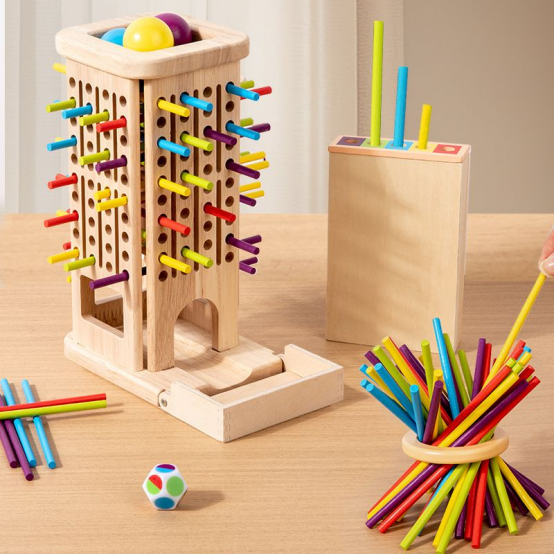
Logical thinking development isn’t limited to specific Montessori toys. Everyday life is a free, massive laboratory:
- Kitchen classifier: Ask children to sort fruits and vegetables by type, color, or size into baskets.
- Laundry pairing game: Match socks while folding clothes—practicing visual discrimination and one-to-one correspondence.
- Building sequences: Use blocks or books to create a “staircase,” each level having one more or less than the previous.
- Story logic: When narrating familiar books or daily routines, emphasize order: “First we went to the park, then we ate lunch, then we took a nap…”
These activities silently reinforce the core thinking framework established through Montessori rod sets: order, classification, sequence, and causality.
Parent Q&A
Q: My child always arranges incorrectly. Should I correct immediately?
A: Restrain the impulse to correct! In Montessori philosophy, discovering errors is more important than getting the right answer directly. When a child misarranges, their brain undergoes the most valuable learning cycle: observe results → notice disharmony → think backward → adjust strategy. Immediate intervention interrupts this process. You can, after completion, admire the work and gently ask, “Shall we go from shortest to longest? Does it feel like walking up stairs?” Guide them to observe and find inconsistencies themselves.
Q: How long can this Montessori toy be used? Won’t it get boring once mastered?
A: That’s the depth of classic Montessori design. For 4-year-olds, basic length sorting is the primary goal. As ability grows, new uses emerge: 1. Reverse sorting: longest to shortest. 2. Concrete “number” representation: assign number cards to rods, linking quantity with symbols. 3. Simple addition: combine rods representing 2 and 3, compare with 5. 4. Creative building: combine with other blocks to create layered structures. It’s a “smart toy” that grows with the child, revealing new levels continuously.
Conclusion: Gift Your Child “Touchable Logic”
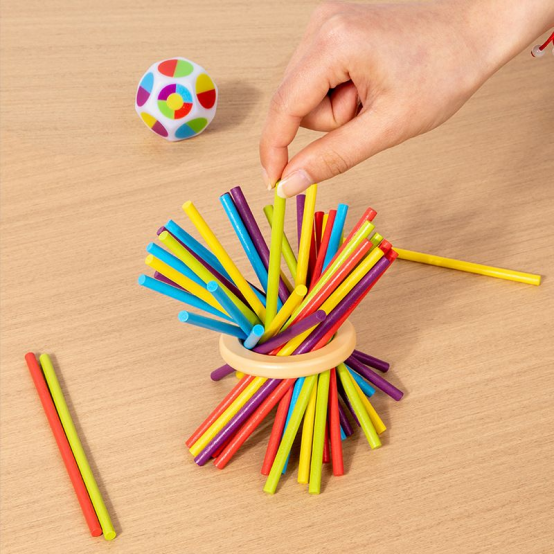
At ages 4–6, when logical thinking surges, our role is not to impart knowledge but to provide tangible objects that the mind can grasp. Abstract logical relationships need to become something children can place with their hands, inspect with their eyes, and sense with their bodies.
The Montessori Rod Set is such a gift. Quiet and unflashy, it simply presents length as a fundamental variable. In working with it, children build their first framework of order, sequence, and comparison.
The confidence and clarity gained from constructing this understanding with their own hands cannot be provided by passive entertainment. Investing in such a toy is not merely acquiring an object but offering a solid, orderly, beautiful foundation for a child’s rapidly developing inner world.