Have you ever envied the calm and orderly atmosphere of a Montessori classroom? Children focus deeply on their work, and each toy seems to silently extend an invitation. Then you glance around your own living room—
Montessori toys scattered everywhere, storage bins overflowing with noisy, flashy plastic pieces—and sigh: “My space is so small, and there’s so much stuff. How could I possibly create that environment?”
Here’s a secret: you absolutely can. You don’t need a dedicated playroom or a major renovation. The essence of Montessori lies in a “prepared environment,” centered on a corner that invites meaningful exploration.
Today, we’ll break it down step by step: how to transform even a small area into a dedicated Montessori home sensory corner. This will not only change how your child plays but also bring a surprising sense of calm to your life.
Why Children Need a Dedicated “Sensory Corner”
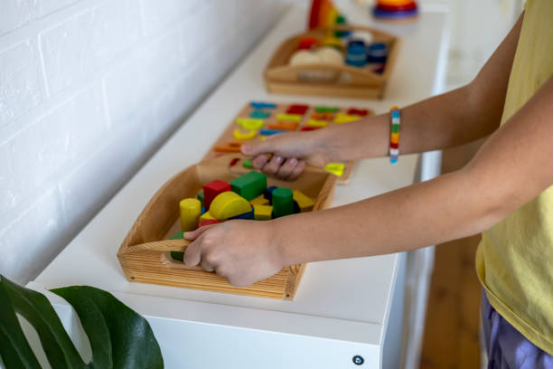
Before diving in, let’s consider why. A cluttered space with too many choices is a cognitive burden for children, leading to:
- Choice fatigue and shallow play: Children may touch everything briefly, unable to focus deeply on any one activity.
- Interrupted concentration: The clutter itself creates visual “noise.”
- Increased dependence: Unsure what to do next, children rely on adults for entertainment.
A well-prepared sensory corner does the opposite:
- Clear invitation: Limited, beautifully displayed choices let children immediately see and decide which “work” to engage in.
- Supports deep focus: An orderly environment reduces distractions, allowing immersion in exploration.
- Fosters independence and order: Children learn to choose work, complete it, and put things back, cultivating respect for self and environment.
- Develops core skills: For 4-6-year-olds, sensory exploration is foundational for math, language, and scientific thinking.
Four Steps to Build Your Home Sensory Corner: From Vision to Reality
Step 1: Location & Layout—Find Your Home’s “Quiet Spot”
You don’t need a full room. Look at your home with fresh eyes:
- Ideal spot: A quiet corner in the living room or child’s bedroom, under a blank wall, or beneath a spacious window ledge. Keep it away from high-traffic areas and major distractions like the TV.
Core elements:
- Natural light: Choose a spot near sunlight if possible; warm light fosters calmness.
- Low viewpoint: Look from your child’s perspective (kneeling or sitting). Is it tidy and inviting?
- Defined space: Lay a rug or mat to visually and tactilely mark the “work area.” This also absorbs sound, aiding concentration.
Step 2: Choose Display Furniture—Simplicity is Key
Expensive Montessori furniture exists, but you can start with what you have.
- Core piece: A low shelf—the heart of the sensory corner. A simple 2–3 tier bookcase works. Height should allow children to reach the top shelf easily (usually not exceeding their height).
- Essential accessories: Trays or small baskets organize small Montessori toys. Each set of materials in a tray helps children retrieve and return items, maintaining order, and presenting each as a “work invitation.”
- Optional: A small table and chair for desk-based activities, though many sensory works can be done on the rug.
Step 3: Select Core Sensory Toys—The Wisdom of Less is More
This is the most critical step. Shift from “more is better.” Your low shelf is a curated display, not a storage warehouse.
- Quantity principle: Start with 2–3 activities per shelf (in trays or baskets). 6–8 items total suffice to offer variety without overwhelm.
- Selection criteria: Prioritize open-ended Montessori toys providing concrete sensory input. Avoid battery-operated or single-purpose plastic toys.
Begin with the first core module: tactile exploration.
Why start with touch? Skin is the largest, earliest-developed sense. Tactile exploration calms emotions, enhances focus, and lays the foundation for language (describing textures) and scientific observation (comparison and classification).
Step 4: Build the Tactile Core—Let Fingers Travel
Here, include a Montessori toy offering rich, contrasting textures. Enter the Montessori fabric drum.
Place it on a neutral-colored tray on the middle shelf. It looks like a solid wooden cylinder wrapped in different fabrics: silky smooth satin, coarse burlap, and soft lambswool.
For the child, this is not just a toy—it’s a “texture universe.” They explore with palms and fingertips, feeling sudden transitions from smooth to rough, rolling the drum, and listening to gentle sounds as it rubs the rug.
This process develops:
- Tactile discrimination & memory: Creating sensory records of “smooth,” “rough,” and “soft.”
- Language: Children seek words to describe sensations or learn vocabulary you provide (“Does this part feel bumpy?”).
- Hand-eye coordination & bilateral use: Rolling and stabilizing the drum requires both hands.
- Focus & meditative exploration: Repetitive touching and rolling calms attention to the present.
The Montessori fabric drum exemplifies Montessori principles: abstract sensory experience becomes a manipulable, explorative object. It’s a timeless classic anchor for your sensory corner.
Maintaining the Sensory Corner: The Art of Rotation
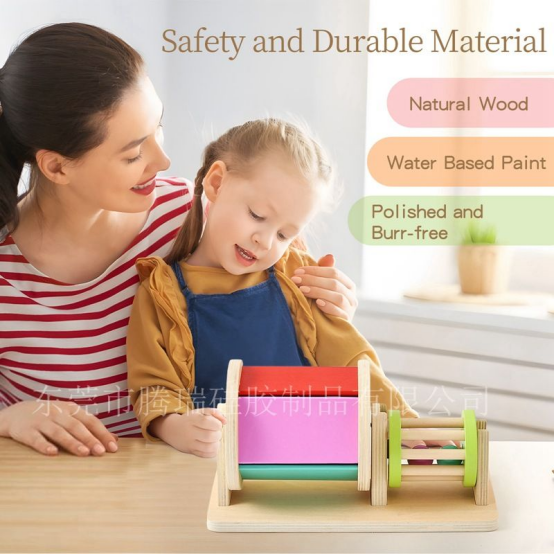
Your sensory corner is not static. Toy rotation maintains novelty and challenge.
Observe your child: when they lose interest or master a work, it’s time to rotate.
- “One in, one out” principle: Change 1–2 Montessori toys at a time. Clean and store temporarily removed items, and reintroduce them weeks later as “new friends.”
- Adjust with development: Introduce more complex challenges as skills grow, e.g., combining the fabric drum with blindfolded texture guessing.
Frequently Asked Questions
Q: My apartment is very small. Can I still set up such a corner?
A: Absolutely! Small spaces benefit from orderly design. A four-compartment low bookshelf (around 60 cm wide) suffices as an efficient mini sensory corner. Vertical use and minimal display are key. Even a large tiered tray on a mat can serve as a “mobile sensory corner.” Remember, quality over quantity.
Q: Beyond a fabric drum, what other items can enrich the sensory corner?
A: Nature and your kitchen are treasure troves. Place in small baskets:
- Natural items: smooth pebble, rough pinecone, piece of bark, dried leaf.
- Kitchen items: stainless whisk (visual & tactile), sponge (dry & wet), various dry beans or pasta in sealed jars for visual & auditory exploration.
- “Texture boards”: homemade cards with sandpaper, silk, aluminum foil, and velvet.
These free materials complement professional Montessori toys, expanding sensory experiences.
Conclusion: Start with a Corner, Transform the Meaning of Play
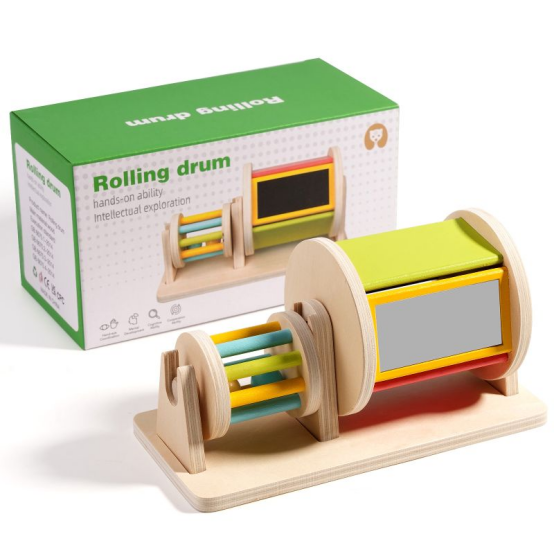
Creating a Montessori home sensory corner conveys a clear message to your child: “Here is a space prepared just for you, where you can explore quietly and think deeply.”
This is no longer a chaotic battlefield requiring constant tidying. It becomes a self-maintaining harbor nurturing inner order. Begin with a rug, a low shelf, and a core toy like the Montessori fabric drum—designed to ignite tactile curiosity. You will witness deeper focus, longer independent play, and the pure spark of discovery in your child’s eyes.