
If you’ve ever had the chance to quietly step into an authentic Montessori classroom, or glimpsed images of one online, your first impression might be, “This place… seems a bit ‘empty’?”
No colorful plastic castles, no flashing electronic screens, and no piles of cartoon characters. Instead, you see low wooden shelves neatly displaying seemingly “plain” items: sets of cylinders in different sizes, wooden rods painted red and blue, geometric shapes in delicate baskets, or a drum covered with various fabrics.
For an adult used to the sensory bombardment of modern toy stores, you might wonder, “These are the so-called Montessori toys? They look… too simple. Will children really play with them?”
Today, let’s become “educational detectives,” quietly exploring this orderly space, uncovering the astonishing design secrets behind these seemingly ordinary, yet globally celebrated Montessori classics. You will see that their simplicity is the pinnacle of educational wisdom.
First, Forget “Toys”—Imagine “Work Materials”

To understand these objects, we need a critical shift in thinking. In Montessori philosophy, they are not called “toys” but “work materials” or “teaching aids.”
This shift is crucial. It implies:
- Different purpose: Toys aim to entertain, while work materials guide purposeful, self-constructed activity to develop specific abilities.
- Different role for the child: With Montessori toys, the child may be a passive consumer; with work materials, the child is an active, focused worker and explorer.
- Different role for adults: We are not providers of entertainment but preparers of the environment and quiet supporters.
These carefully designed Montessori materials form the core of a “prepared environment.” They are not scattered randomly but are like invitations waiting for the child to unlock, each with intrinsic appeal.
Why Classics Endure: Four Design Secrets That Can’t Be Imitated
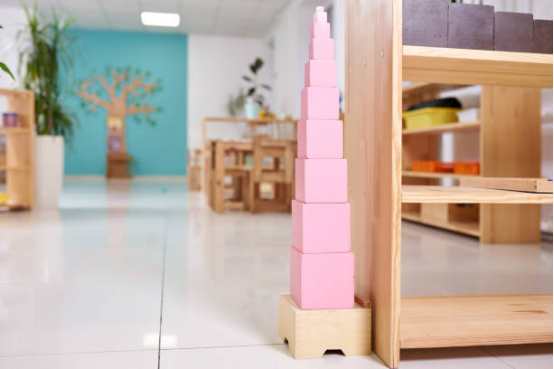
Why do these simple wooden items remain respected by top early education experts, crossing cultures and centuries? They contain four design secrets that cheap imitations cannot match.
Secret 1: Isolation of Qualities—A Lesson Focused on a Single Point
This is the core principle of Montessori materials. A quality set focuses on a single sensory or cognitive concept while minimizing other distractions.
Take the classic wooden shape-stacking Montessori toy as an example. Imagine it: a solid wooden base with cutouts for different shapes (circle, square, triangle) and matching solid blocks, made of natural wood with smooth, warm edges.
Design details to note:
- Single or natural color: The shapes are either natural wood or uniformly painted in soft colors. This isolates the shape quality. Multiple colors would distract the child from focusing on shape.
- Only the relationship of shape and hole: The goal is clear: match each 3D shape to its corresponding hole. No sounds, no lights, no secondary games. The design spotlights the child’s challenge: observing geometric properties and completing spatial matching.
This isolated difficulty respects the child’s cognitive process, enabling full attention on one clear goal and achieving a pure, solid sense of success.
Secret 2: Built-In Error Control—The Silent Mentor
Montessori’s most revolutionary design element is built-in error control. Children do not need a teacher or parent to tell them right from wrong; the material itself provides feedback.
Returning to the shape-stacking Montessori toy: when a child tries to fit a triangle block into a circular hole, it won’t go. Trying to place a square block incorrectly also fails. Only when aligned correctly does it fit smoothly. No one says “wrong”—the material communicates through physical properties. Children receive feedback through senses and adjust strategy independently, cultivating independence, logical thinking, problem-solving, and resilience.
Secret 3: Child-Sized, Real, and Beautiful
Montessori believed children should interact with real, beautiful, orderly objects. Classic Montessori toys:
- Use natural materials—wood, glass, metal, and cotton—providing rich sensory experiences impossible with plastic.
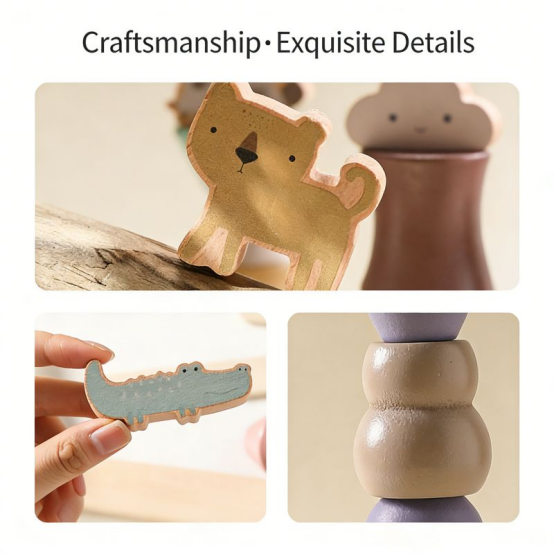
- Exquisite workmanship: Smooth surfaces and rounded edges ensure safety and provide a pleasurable tactile experience, nurturing aesthetic appreciation.
- Child-appropriate size: Lightweight and easy for 4–6-year-old hands to manipulate, boosting self-efficacy.
Secret 4: Repeatable Actions and Progressive Challenges
True classics are not “one-time-use” toys. They can be repeatedly explored, each time offering new learning.
For example, after initially placing all shapes correctly, children might later try blindfolded matching, elevating visual practice to advanced tactile discrimination.
Case in Point: Multidimensional Development With Shape Stacking
When a child interacts with the Montessori shape-stacking toy:
- Visual discrimination: Differentiating circles, squares, and triangles—a foundation for future letter recognition.
- Hand-eye coordination and fine motor skills: Using three fingers to grasp, rotate, and align blocks, preparing for writing.
- Spatial awareness and geometry: Understanding rotation, correspondence, and insertion, and perceiving basic geometric properties.
- Problem-solving and logic: The trial-error-feedback-adjustment cycle fosters early scientific thinking.
- Focus and sense of order: Completing a structured task brings satisfaction and nurtures deep concentration.
No preaching, no isolated drills—development integrates into self-motivated, manipulable “work.” This is why classic Montessori materials are called “intelligent materials.”
Common Myths About Classic Materials
Q: Are classic Montessori toys really that different from cheap imitations in stores?
A: The difference is profound and directly impacts learning outcomes. Cheap imitations often sacrifice core design:
- Inaccurate dimensions: error control fails, confusing the child.
- Poor materials: light, rough composites or plastic lack sensory realism and safety.
- Distracting design: unnecessary colors, numbers, or letters disrupt the “isolation of qualities” principle.
Choosing authentic classic materials invests in century-tested, sophisticated educational design, ensuring pure, effective learning.
Q: If a child quickly masters placing all shapes, is the Montessori toy useless?
A: Not at all. Repetition reinforces neural pathways, confidence, and focus. Parents can introduce advanced challenges like blindfolded matching. Even if temporarily stored, the Montessori toy offers new exploration when revisited. Classics provide depth and openness, supporting growth at different stages.
Conclusion: Bringing Classroom Wisdom Home
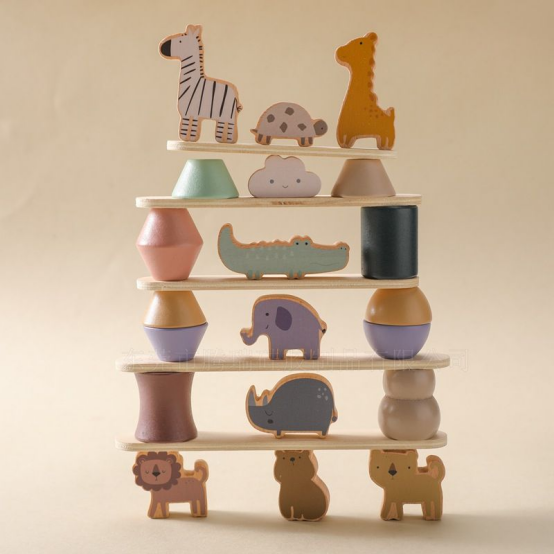
The quiet and order in a Montessori classroom come not from strict rules but from toys—these “work materials” attract children and guide them appropriately. They do not force or entertain; they wait silently for children to explore, think, and discover the beauty of order and their own capability.
Parents need not replicate an entire classroom but can bring this design wisdom home. Starting with a true classic like the wooden shape-stacking Montessori toy provides more than a toy: it offers a concentrated, efficient learning environment where children work independently, grow autonomously, and experience their increasing competence.
In a world full of overstimulation, this gift of simplicity and wisdom may be exactly the quiet, focused starting point a child needs. Let the light of classics illuminate your home play space.