
Have you ever glanced at your shopping cart filled with beautiful Montessori toys, then at your credit card statement, and sighed quietly? “Sigh, for early education, this investment seems unavoidable…”
Stop! Let me share one of Montessori’s most exciting and often overlooked secrets: the true essence of Montessori is not in expensive teaching cabinets, but in your kitchen, backyard, and laundry basket.
Dr. Maria Montessori’s earliest work began with children from low-income families. Her philosophy was “Help me to do it myself,” and the best environment to achieve this is the child’s everyday real-life world.
Today, I will unlock 5 truly “zero-budget” games. They require no new purchases—just a keen eye and playful spirit. You will find that these daily-object-based Montessori activities precisely stimulate brain development, attention, order, and logical thinking. Ready? Let’s turn your home into the best Montessori classroom!
Game 1: Bean Sorting Expert—A Mini Laboratory for Focus and Fine Motor Skills
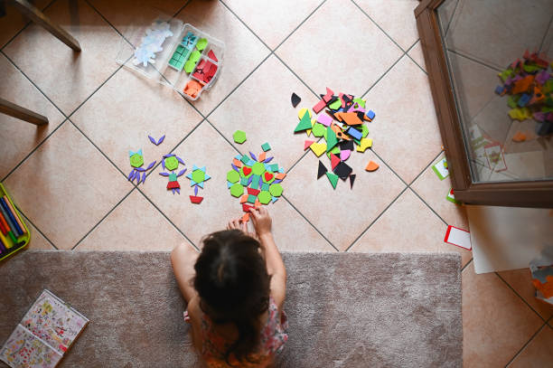
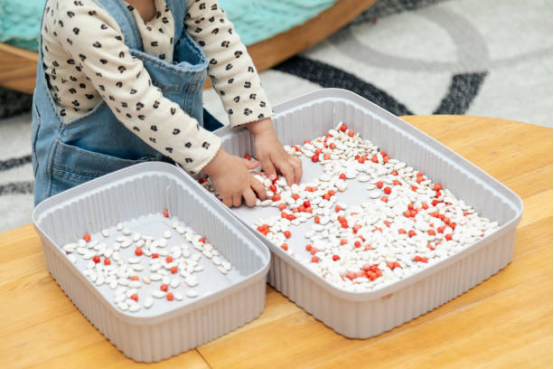
You need different types of dry beans or pasta (chickpeas, lentils, and fusilli), several small bowls or ice cube trays, and a spoon or child-friendly tweezers (optional).
How to play: Pour mixed beans into a large bowl. Show your child how to sort different types into separate containers using a spoon or fingers (for younger children). For 4–6-year-olds, introduce tweezers for extra challenge and fun.
Montessori insights:
- Focus training: This visually detailed task keeps children quietly engaged for 15–20 minutes.
- Fine motor development: Using tweezers or fingers strengthens hand muscles needed for writing.
- Math readiness: Sorting, one-to-one correspondence, and counting naturally introduce basic math concepts.
- Sensory input: Different shapes, sizes, colors, and textures provide rich sensory stimulation.
Game 2: Sock Matching Challenge—Bridging Life Skills and Visual Discrimination
You need: a basket of clean, rolled-up socks.
How to play: Invite your child to be your “laundry helper,” matching each sock with its pair. Afterward, encourage them to roll the socks themselves.
Montessori insights:
- Practical life skills: Real, purposeful chores enhance independence and a sense of belonging.
- Visual discrimination: Matching patterns, colors, and stripes prepares them for future letter recognition.
- Order and logic: Completing the task requires clear steps: take out socks, observe, pair, and organize.
Game 3: Sponge Water Transfer—A Calm Ritual for Senses and Coordination
You need two small bowls, a small sponge, some water, and a tray (to contain spills).
How to play: Pour a small amount of water into one bowl. Show your child how to soak the sponge, then carefully transfer the water to the empty bowl by squeezing. Repeat until all water is transferred.
Montessori insights:
- Hand-eye coordination and arm strength: Controlling water flow and aiming require precision and coordination.
- Sensory exploration: Feel water temperature, sponge texture changes, and squeezing sensations with sound.
- Focus and mindfulness: Slow-paced with clear results, naturally calming, bringing attention to the present.
- Understanding cause and effect: The act of squeezing produces a visible water flow outcome.
Game 4: Sound Matching—Awakening the Overlooked Auditory Sense
You need several opaque small bottles or sealed containers (like old spice jars) and items that produce different sounds (rice, beans, small bells, and paper clips).
How to play: Make two sets of sound-matching “sound tubes.” Shake and match sounds with your child. Upgrade to blindfolded sound-guessing for an extra challenge.
Montessori insights:
- Auditory discrimination: Trains keen hearing in a visually dominant world.
- Memory and matching: Remember sound characteristics and match them, boosting working memory.
- Language development: Encourage descriptive words (“rustling,” “ding-ding,” “thud”).
Game 5: Natural Material Touch Board—Sensory Treasures at Your Doorstep
You need: a basket and outdoor finds from a walk.
How to play: Collect safe natural items: smooth stones, rough bark, spiky pinecones, soft feathers, and dry leaves. Display them in the basket and invite your child to touch and guess with eyes closed.
Montessori insights:
- Tactile development: Direct, rich sensory exploration surpassing artificial materials.
- Connecting with nature: Cultivates observation, curiosity, and respect for the natural world.
- Descriptive language: Encourage adjectives: rough, smooth, hard, soft, prickly, light.
When Children Love Matching & Sorting: How to Support Deeper Exploration
You may notice your child is obsessed with pairing and sorting! They focus on beans and love finding sock pairs repeatedly.
This is a clear developmental signal. The child is in a sensitive period for order and classification. Their brain works to extract patterns and build cognitive frameworks.
Daily life games meet initial exploration needs but may reach material limits (limited bean types, random sock patterns). This is the perfect moment to introduce professional Montessori toys with more isolated and precise goals.
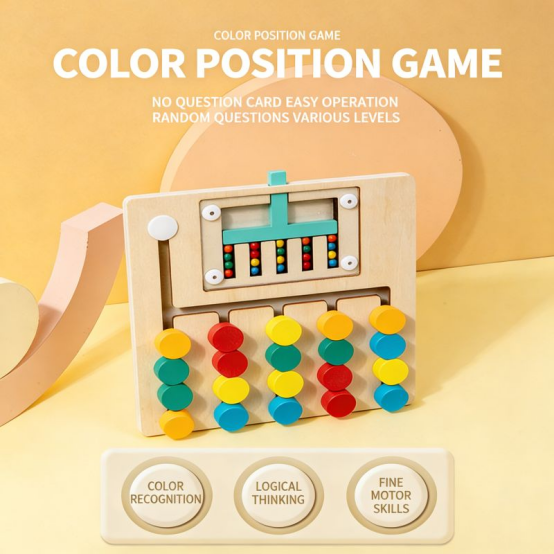
For example, if your child shows strong interest in color matching, consider color-matching learning Montessori toys.
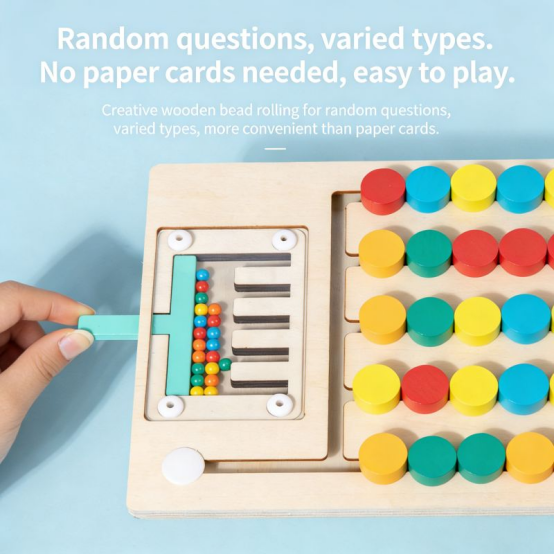
This set distills “color matching” from random household objects into a precise learning tool: a set of solid-colored wooden pieces with a color-block base. No distracting patterns, no size differences—the focus is solely on color. This isolated design lets attention focus like a laser on the core goal: color recognition.
The child’s work evolves from “finding a matching sock” to “finding the unique red home for this red piece.” This process:
- Clearer: Single, well-defined goal, reducing cognitive confusion.
- More challenging: Subtle color differences require keen observation.
- Built-in self-correction: Misplacement is visually obvious; the child can adjust independently.
- Systematic cognition: Reinforces color recognition in an ordered way, laying groundwork for complex color classification.
Transitioning from life games to professional tools is not an “upgrade,” but a deepen-and-support process. Free resources awaken interest; professional tools extend learning depth and structure.
Tips for Game Time
Q: What if Montessori toys like bean sorting get messy? Isn’t that creating chaos?
A: That’s part of the learning! Montessori emphasizes the entire work cycle: 1. Prepare workspace (mat), 2. Focused work, 3. Clean-up. Have a small broom and dustpan ready, and invite your child to help clean. The process teaches responsibility and respect for the environment. A tray or baking sheet can contain mess initially.
Q: These Montessori toys seem suitable for various ages. Will my 4–6-year-old still enjoy them?
A: Absolutely! Adjust presentation and difficulty. For 4–6-year-olds:
- More precise sorting (e.g., by size and color simultaneously).
- Use tools (tweezers, spoons).
- Introduce counting and recording (“How many of each bean?”).
- Add complex steps (e.g., creating patterns after sorting).
This age group craves real, challenging tasks, perfectly met by these activities.
Conclusion: The Best Education Begins with Seeing
The core message: you don’t need the perfect toy to practice Montessori. The best educational tools are observant eyes and trustful hands-off guidance.
These free games are a window to connect with your child and observe developmental interests. When you see their eyes sparkle with focused attention, you know you’ve reached a sensitive developmental point.
Then, if you choose to introduce a professionally designed tool like color-matching learning Montessori toys, you are no longer consuming blindly—you are a sensitive supporter, providing a key to unlock your child’s inner potential, helping them walk confidently and deeply on their chosen path.
[Turn Everyday Objects into a Montessori Learning Adventure Today]
From today, open your cupboards and look around your living room. Educational opportunities are everywhere. Let’s turn life into the most vivid and warm classroom.