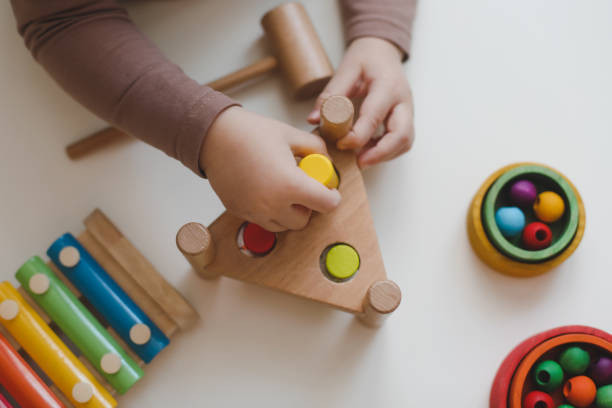
Walking into a home with preschool-aged children, you almost always see the same “scene”: a corner of the living room turned into a toy graveyard. Plastic blocks, plush animals, toy cars, and puzzle pieces spill out of storage bins. The child sits in the middle, bewildered, picking up a toy, shaking it, tossing it aside, and moving on to the next.
The Montessori toys you spent so much money and thought on are buried at the bottom of this colorful sea, losing the chance to be seen and explored.
If this scene feels familiar and you’re exhausted from endless tidying, today’s content is for you. We won’t talk about buying new toys, but about a magical topic: how a simple “toy rotation system” can make every toy you already own—especially well-designed Montessori tools—shine again, fundamentally changing the way your child plays.
Why More Toys Can Make Children “Bored”
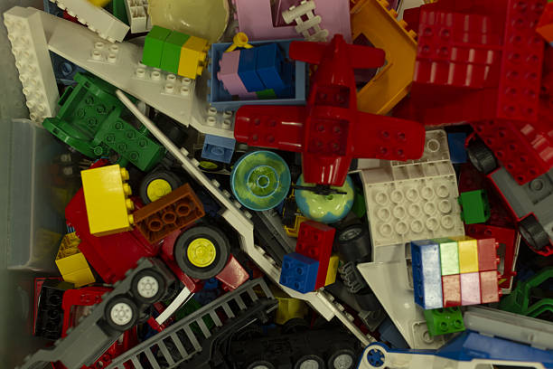
It sounds counterintuitive, but psychology and developmental research support it: too many choices lead to decision paralysis and shallow engagement.
Imagine walking into a supermarket aisle with 200 sauces versus one with 10 carefully selected sauces—which is easier to choose from? For children, a mountain of toys overloads their brain. The result:
- Distracted attention: Every Montessori toy competes for their eyes; focus on any single activity is impossible.
- Shallow play: Rapid switching prevents deep, patient exploration.
- Suppressed creativity: When everything is readily available, there is little motivation to innovate or dig deeper.
- Wasted Montessori toys: They need to be seen and calmly chosen to provide value in focused work.
The secret of Montessori classrooms’ calm focus is limited choices. Shelves display a small number of activities, each clearly visible and accessible. This reduces distractions and respects the child: we trust they can find work that meets their inner developmental needs from a limited selection of high-quality Montessori toys.
Building Your Montessori-Style Rotation: 4 Simple Steps to Reshape Play Space
Setting up a toy rotation system isn’t a massive cleanup—it’s a sustainable, dynamic family habit. Let’s start.
Step 1: Gather and Gentle Decluttering
Choose a time when the child is away or resting quietly. Gather all the toys in one place, e.g., on the living room carpet. The sheer volume will surprise you.
Start the first sort:
- Keep zone: Open-ended toys, building sets, art materials, and all Montessori toys—typically natural materials, simple designs, and open-ended play.
- Temporary zone: Outgrown baby toys, incomplete sets, noisy or single-purpose plastic toys. Consider donating, recycling, or temporarily storing.
- Discard zone: Broken, unsafe, or uncleanable items.
Mindset: this isn’t a “battle” with your child’s toys. The goal is not to throw away beloved items but to enhance enjoyment of the remaining toys. You may keep a “sentimental box” for a few especially cherished plush toys or blankets, which don’t participate in rotation.
Step 2: Categorize and Curate—Create Your “Montessori Toy Library”
For the keep zone, categorize toys like a librarian:
- Sensory exploration: Cloth drums, sand, water play tools
- Construction & spatial: Blocks, magnetic tiles, shape-matching toys
- Practical life & fine motor: Bead threading, buckle toys, sweeping sets
- Art & creativity: Playdough, crayons, drawing boards
- Math & logic: Sorting sticks, counting materials
Your goal: a “toy library.” Many toys exist on the shelf, but you don’t pile them all at the child’s desk. Pull out only a few each time.
Step 3: Plan Display—Make the Invitation Obvious
This is the most Montessori step. Choose a display area: a low shelf or open storage bins. Select 1–2 toys from each category, totaling 6–10 toys, beautifully arranged.
- Use trays or baskets: Keep all parts of a toy together, defining “one work unit,” making it easy for retrieval and return, and making it visually appealing.
- Leave space: Don’t crowd the shelf. Let each toy be clearly seen, as if quietly saying, “Choose me.”
- Include a core Montessori toy: Ensure at least one toy, like a Montessori bead-matching set, provides deep, repetitive work.
The rest are stored in opaque boxes or cabinets—your “library warehouse.”
Step 4: Set Rotation Rhythm—Observe, Not Calendar
Rotation has no fixed schedule; the child is the guide.
- Observation: When interest in most toys wanes or the child repeatedly plays with one or two, it’s time to rotate.
- Small batch rotation: Change only 1–3 toys at a time. Bring in an “old friend” or a “new friend” from storage.
- Make it a ritual: Invite the child to participate (“Shall we rotate the shelf toys this weekend?”) to cultivate environmental management awareness.
Core Example: How a “Old Favorite” Montessori Bead-Matching Toy Gets New Life
Track a toy’s journey in the rotation system:
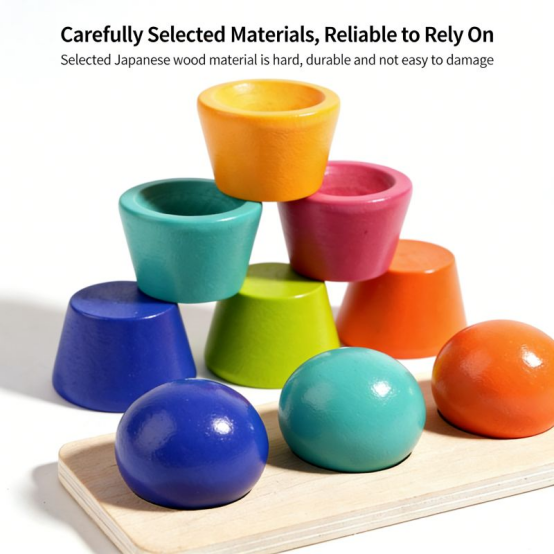
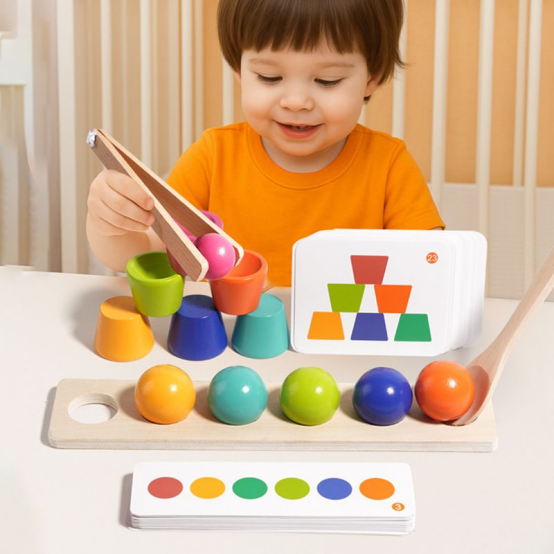
Week 1: A bead-matching toy displayed on a wooden tray: colorful beads on the left, a grooved wooden board on the right with matching colors, plus a small wooden tweezer. For a 4–6-year-old, it’s a perfect challenge. Initially, they focus on picking beads, enjoying fine motor control, and placing them in matching slots.
Week 3: Mastery achieved, interest fades. Remove, clean, and store in the “practical life” box; replace with a long-unplayed block set.
Week 6: Rotate blocks and bring back the bead toy with a small change: add a paper card showing a color sequence (e.g., red-blue-yellow-green). The child sees the “old friend” with novelty, engaging in a new challenge—sequencing, color recognition, and fine motor control simultaneously.
Deeper value:
- Focus & repetition: Even without new challenges, repetition for mastery and order cultivates deep concentration.
- Skill consolidation & expansion: Rotation “breaks” allow mature re-engagement, inspiring self-created activities like counting or classification games.
- Extended toy lifecycle: Well-designed Montessori toys never “expire.” Rotation prevents neglect, making them periodic “important partners” in development.
Beyond Rotation: Care and Mindset
- Cleaning & respect: Wipe toys with the child before returning to storage—teaches value and respect for work materials.
- Mindset: If a child requests a stored toy, gently explain, “The drum is on ‘vacation’ for now; see if you like a new friend on the shelf.” This helps learn patience and adaptability.
Common Questions About Toy Rotation
Q: My child cries for a toy just stored away—what to do?
A: Empathize: “I know you miss the red car; you had fun.” If emotions run high, bring out the toy and agree to store another less-needed toy. Gradually, they learn the rotation rhythm. Avoid power struggles; the goal is a better play experience, not strict rule enforcement.
Q: How often should I rotate? Weekly feels rigid.
A: Forget fixed calendars! Observation-based rotation is best. When interest in the current display declines (usually 1–3 weeks), rotate. Sometimes changing just one “underused” toy rekindles interest in the whole shelf. Trust your observation, not the date.
Conclusion: From Chaos to Cycle, Giving Toys a Second Life
Establishing a toy rotation system is more than tidying the living room—it’s a profound parenting paradigm shift:
- For you: from exhausted “cleaner” and “entertainment director” to calm environment engineer and observer.
- For the child: from overwhelmed “consumer” to capable chooser and deep explorer.
- For Montessori toys: from buried treasure to periodic star actors providing appropriate challenge.
The greatest beneficiaries are classic toys like Montessori bead-matching sets, designed for depth, repeated exploration, and skill progression. They never “wear out,” instead revealing new educational layers with each return.
Stop letting valuable toys sleep in chaos. Starting this afternoon, with a box, a low shelf, and a bit of planning courage, create a calmer, more focused, and discovery-rich play space for you and your child. You’ll find fewer toys bring more joy and growth.