
Walk down any toy aisle or scroll through online marketplaces today, and you’ll see it: the “Montessori” label. It’s slapped on everything from simple wooden blocks to flashy plastic gadgets. As a parent, it’s confusing. Is it just a marketing trend, or does it mean something real? Here’s the truth: a truly Montessori toy isn’t defined by a logo or a brand. It’s defined by a century-old educational philosophy that understands how children learn best. It’s about intentional design that serves the child’s developmental needs, not an adult’s desire for a quiet, occupied kid.
So, how do you spot the real deal amidst the noise? Let’s move past the label and dive into the core principles that transform a simple object into a powerful tool for growth. This is your decoder ring for building a purposeful play space.
Beyond the Label: It’s About Purpose, Not Aesthetics

A beige, wooden toy isn’t automatically Montessori. A colorful plastic one isn’t automatically disqualified (though natural materials are a strong clue). The essence lies in what the toy does—or rather, what it allows the child to do.
Dr. Maria Montessori observed that children are naturally driven to learn through purposeful activity. They crave order, mastery, and independence. Authentic Montessori toys, often called “materials” or “works,” are meticulously designed to channel this innate drive. They aren’t for passive entertainment; they are for active, concentrated work that builds the mind and the sense of self.
Let’s break down the non-negotiable characteristics.
1. Built from Reality: Natural Materials & Sensory Truth
The first telltale sign is in the hand-feel. The best Montessori toys are overwhelmingly made from natural materials: solid wood, cotton, metal, glass, wicker. Why?
- Sensory Integrity: A wooden block has a specific weight, temperature, and grain. A fabric swatch has a true texture. These materials provide an accurate sensory feedback loop that plastic, which is often uniform and lightweight, cannot replicate. This connection to the “real world” is fundamental.
- Durability & Respect: Natural materials are often more durable and age beautifully. They communicate to the child that their work is valuable and worthy of well-crafted tools.
- Focus & Calm: The subdued, natural color palette of wood and neutral fabrics creates a calm, uncluttered environment. It allows the child’s focus to settle on the task (stacking, sorting, matching) rather than being hijacked by a jarring light or sound.
See It in Action: Our Montessori Fabric Drum is a sensory lesson in material truth. Its surface isn’t printed with textures; it’s covered in distinct fabrics—maybe a smooth satin, a nubby linen, or a soft fleece. As a child rolls it and feels each patch, they’re building a genuine tactile memory and vocabulary. This is sensory learning in its purest form.
2. The Beauty of a Single Focus: Isolation of Difficulty
This is a cornerstone principle. A conventional toy might sing the alphabet, count to ten, and flash three colors all at once. It’s overwhelming and teaches the child to be a passive spectator.
A true Montessori learning toy isolates one skill, one concept, and one challenge.
- The Goal: To allow the child to master that one thing deeply without distraction. This builds concentration and a clear sense of accomplishment.
- The Design: The material will often have a “control of error” (more on that next) built into that single task. The child’s entire cognitive energy is directed toward solving that specific puzzle.
See It in Action: Look at the Montessori Cylinder Set. Its purpose is singular: discriminate size. Not color, not shape names—just dimension. Each of the four blocks isolates a different aspect (height, diameter, or both). The child’s mind zeros in on comparing and matching. Similarly, our Montessori Color Matching Learning Toy focuses purely on visual discrimination and classification by hue. There are no extra buttons or sounds. This isolation is what makes it such a powerful educational learning tool.
3. The Teacher Within: The “Control of Error”
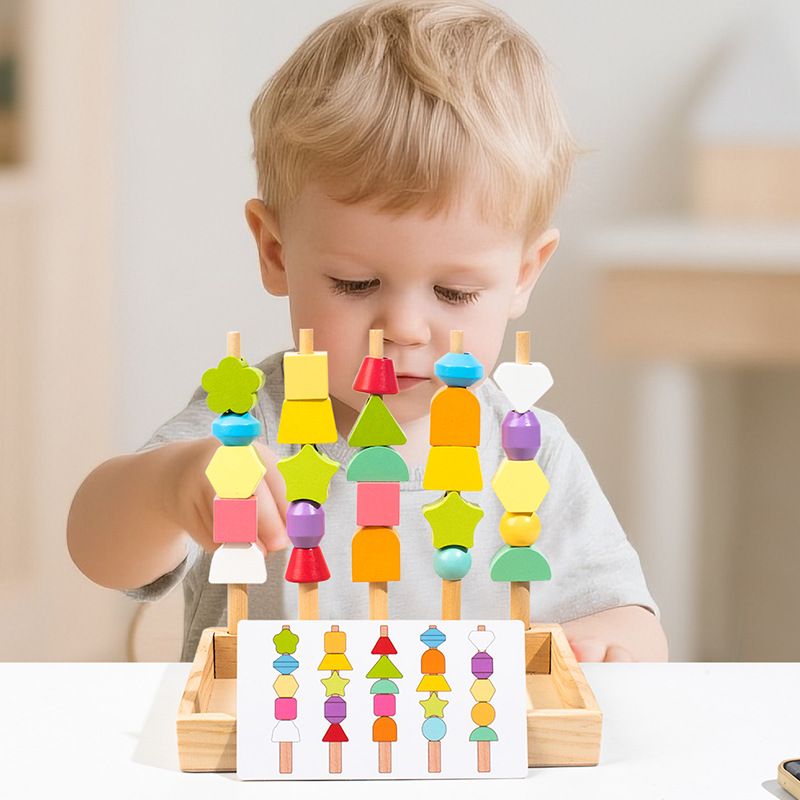
This is perhaps the most genius aspect of Montessori design. The best Montessori toys contain their own feedback mechanism. The child doesn’t need an adult to say “good job” or “try again.” The material itself shows them.
- Empowerment: This fosters incredible independence and self-reliance. The child becomes the evaluator of their own work.
- Problem-Solving: It turns the activity into a puzzle to be solved through observation and correction, building logical thinking and resilience.
See It in Action: With the Cylinder Set, the control of error is physical: a cylinder will only fit perfectly into its correct socket. If one is left over at the end, or a cylinder wobbles, the child knows to re-examine their work. The Montessori Rod Set offers a visual control. When arranged correctly from longest to shortest, the steps create a perfect stair-like progression. A misplaced rod breaks the pattern, visually alerting the child. This built-in guide is what makes these wooden educational materials so effective for independent learning.
4. The Hand is the Pathway to the Brain: Fine Motor Development
Montessori understood that intellectual development is inextricably linked to physical movement, especially the refinement of the hand. Purposeful manipulation is cognitive work.
- Preparation for Life: Many Montessori toys are designed as indirect preparation for real-life skills. The coordination, strength, and precision developed are foundational for writing, dressing, and caring for oneself and the environment.
See It in Action: Our Montessori Bead Matching Toy is a masterclass in this principle. It’s not just about color matching. The use of the wooden clip is deliberate, demanding a precise pincer grip—the exact same finger configuration used to hold a pencil. Every time a child picks up a bead, they are strengthening the fine muscles and neural pathways for future writing. It’s a teaching tool disguised as a game.
5. Open-Ended Potential & Prolonged Engagement
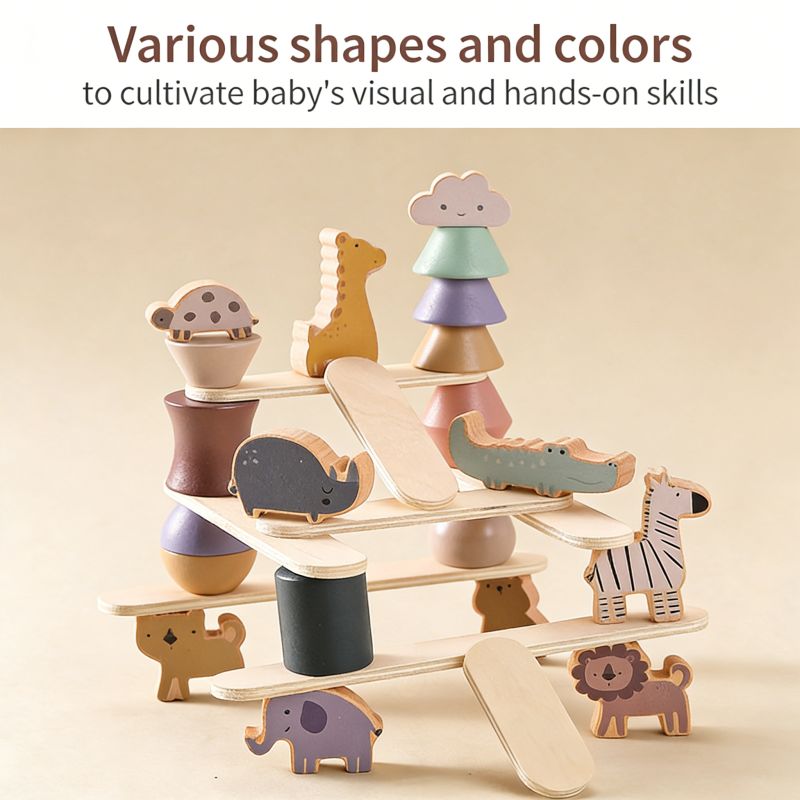
While they isolate a difficulty, great Montessori toys are rarely one-and-done. They offer layers of engagement and adapt as the child grows.
- Repetition is Mastery: Young children crave repetition. A material that can be used the same way repeatedly (like sorting the rods) satisfies this need for order and leads to deep mastery and confidence.
- Extension of Work: Once the primary purpose is mastered, the material can be used for more complex projects. A simple stacking toy becomes a lesson in balance and physics.
See It in Action: Our Montessori Wooden Shape Stacking Toys exemplify this. The primary goal might be matching shapes. But then, it becomes a DIY available building project: “Can I build a tall tower with the rocket on top?” “Can I create a symmetrical pattern?” The forest or outer space themes spark narrative play, blending structured learning with creative storytelling. This extended play value is a hallmark of quality Montessori toys for 4–6-year-olds.
What a Montessori Toy is NOT
To crystallize the concept, let’s flip it. A truly Montessori toy is typically NOT:
- Battery-Operated: It doesn’t need to beep, flash, or talk. The child provides the action and the mental energy.
- Overwhelmingly Complex: It doesn’t try to teach five things at once. Clarity is key.
- Fragile or Purely Decorative: It is a tool for work, meant to be handled, used, and respected.
- Tied to a Screen or App: The learning is fully embodied in the physical, three-dimensional world.
FAQ: Cutting Through the Confusion
Q: Does a Montessori toy have to be expensive?
A: Not necessarily, but it should be well-made. You’re investing in an heirloom-quality tool, not disposable entertainment. The cost per hour of engaged, developmental play is often far lower with a durable, timeless Montessori wooden material than with a cheap plastic toy that breaks or is ignored in a week. Look for solid construction, smooth finishes, and thoughtful design.
Q: My child is very active and doesn’t like to sit. Are these toys wrong for them?
A: On the contrary, these toys can be perfect for an active child. The activity is in the task itself—carrying the long rods, moving cylinders, and rolling the fabric drum. The materials channel physical energy into focused, purposeful movement. The deep concentration they foster can actually be calming for a busy mind and body. Start with more physical materials like the Rod Set or Shape Stacking toys.
Q: How do I know if a toy is “Montessori-aligned” if it’s not a classic material?
A: Apply the principles checklist: Is it made of natural materials? Does it focus on one skill? Does it allow for independent use and correction? Does it promote concentrated, hands-on work? If you can answer yes, you’re on the right track. Many open-ended toys (simple blocks, silks, and play dough) beautifully complement a Montessori environment.
Choosing Montessori toys is an exercise in mindful parenting. It’s about looking past the surface and asking, “What will my child’s mind and hands actually do with this?” It’s a shift from buying toys that simply keep a child busy to curating materials that respectfully support their natural development.
The goal isn’t to create a perfect, sterile home classroom. It’s to incorporate principles that foster independence, concentration, and a genuine love for learning. When you see your child, completely absorbed, working through a challenge on their own and experiencing that quiet glow of self-driven accomplishment, you’ll understand the profound difference a true Montessori toy can make.
Our collection is built on these authentic principles. Each item, from the foundational Montessori Fabric Drum to the intellectually satisfying Cylinder Set, is designed to be a tool for your child’s self-construction. They are invitations to work, to focus, and to grow.
Discover authentic Montessori toys that support independence, focus, and lifelong learning—shop the collection today.