
Let’s paint a familiar picture. You’ve bought the latest, most highly reviewed toy. It lights up, it sings three different songs, and it has buttons that make animal sounds. Your child is thrilled… for about six minutes. Then, it’s discarded on the floor, and they’re back to asking for a screen or bouncing off the walls. Sound familiar?
What if the solution to your child’s fleeting attention span wasn’t more stimulation, but less? What if the key wasn’t a louder, brighter toy but a quieter, simpler one that respects how their brain is wired to learn?
This is the quiet power of genuine Montessori toys. They aren’t designed to capture attention through novelty; they are engineered to cultivate deep, sustained concentration. And this isn’t just philosophical—it’s a practical, observable outcome rooted in child development. Let’s unpack how these unassuming wooden educational tools can transform your child’s ability to focus and why that skill is the ultimate gift.
The Myth of the “Short Attention Span”
First, a liberating truth: young children are not inherently incapable of focusing. In fact, they are masters of concentration when the conditions are right. Have you ever seen a toddler completely absorbed in watching an ant crawl across the sidewalk or a preschooler meticulously pouring water back and forth between cups for twenty minutes straight?
The issue isn’t their attention span. It’s that most modern toys and entertainment are designed to fragment attention. They offer quick hits of dopamine through lights and sounds, training the brain to seek constant new input. In contrast, authentic Montessori learning toys do the opposite: they create the conditions for “flow state” long before we have a word for it.
The Blueprint for Concentration: How Montessori Toys Are Built Differently

So, what’s the secret sauce? It’s not one thing, but a confluence of intentional design principles that work together to support the child’s developing mind. Think of it as architectural support for focus.
1. The “Isolation of Difficulty”: One Job at a Time
This is the cornerstone. A conventional toy might ask a child to recognize a shape and a color and press a button for a reward, all at once. It’s cognitively noisy.
A true Montessori toy presents one clear, isolated challenge. Our Montessori Cylinder Set is a perfect case study. Its entire purpose is size discrimination. Not color, not sound—just the relationship between height and diameter. Because the task is pure and uncluttered, a child’s mind can zero in on it completely. All their mental energy is directed toward observing, comparing, and matching. This laser focus is the birthplace of deep concentration. By removing unnecessary distractions, the material itself teaches the brain how to attend to a single task—a skill that is increasingly rare and valuable.
2. The Genius of “Control of Error”: The Internal Teacher
This is where Montessori design gets truly brilliant. The best Montessori toys have a self-correcting mechanism built right in. The child doesn’t need you to say, “Good job!” or “Try the other hole.” The material provides the feedback.
Take that cylinder set again. If a cylinder is placed in the wrong socket, it will either stick out awkwardly or not fit at all. A child is left with a visual and tactile puzzle: one cylinder remains, or the block looks uneven. The drive to correct this, to create order, comes from within. This internal motivation is a powerful engine for prolonged engagement. They aren’t working for your praise; they are working to solve the puzzle for themselves. This cycle of attempt, error, self-correction, and mastery is profoundly satisfying and utterly absorbing.
3. Purposeful Movement: The Hand is the Tool of the Mind
Montessori famously said, “The hands are the instruments of man’s intelligence.” Concentration isn’t just a mental state; it’s a physical one. When a child’s hands are engaged in a purposeful, challenging task, their mind is anchored to the present moment.
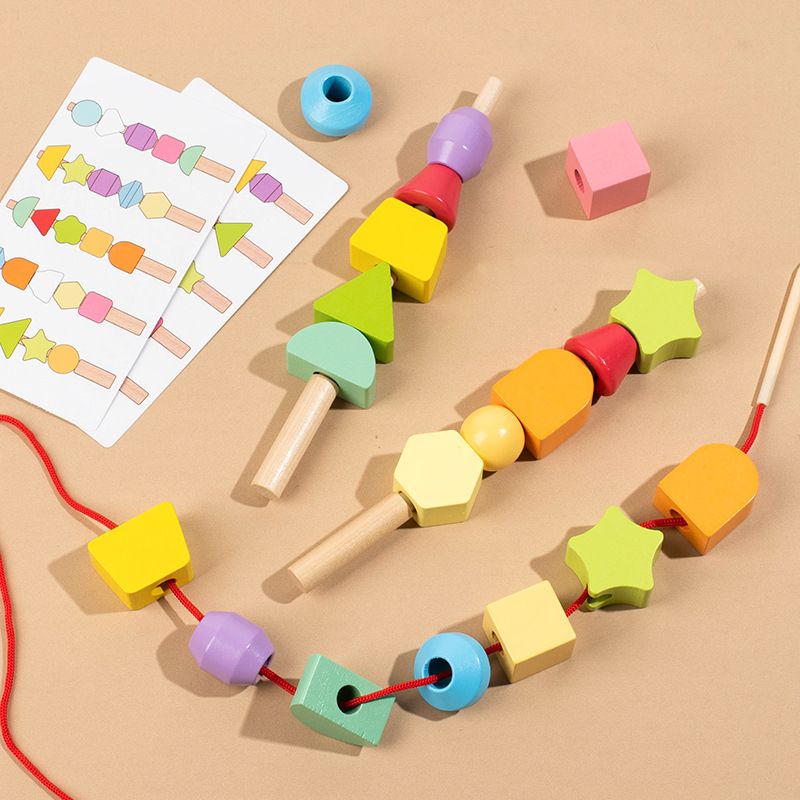
Activities like carefully carrying the longest rod from the Montessori Rod Set or using a pincer grip to place beads in our Montessori Bead Matching Toy require deliberate motor control. This physical engagement prevents fidgeting and mental wandering. The child is embodying their focus. The repetitive, precise nature of the work has an almost meditative quality, calming the nervous system and allowing for deeper cognitive processing.
4. Beauty & Order: An Environment for a Calm Mind
Chaos distracts. Order focuses. Montessori toys, with their natural wood finishes, muted colors, and organized presentation on a shelf, create a visually peaceful environment. This isn’t about being aesthetic for Instagram; it’s about cognitive science. A calm, orderly space signals to the child’s brain that this is a place for thoughtful work. When toys are displayed one-by-one on a tray or in a basket—a key aspect of Montessori toy storage—it invites the child to select one, complete a full cycle of activity, and return it before choosing another. This ritual of order supports an orderly, focused mind.
Beyond the Play Mat: The Lifelong Gift of Concentration
The benefits of this cultivated focus extend far beyond a peaceful afternoon. The ability to concentrate is the bedrock skill for all future learning.
- Academic Readiness: A child who can focus for extended periods is prepared for the demands of a classroom. They can follow a story, work through a math problem, or engage in a science project without being derailed by every minor distraction.
- Emotional Regulation: Deep concentration is intrinsically rewarding and regulating. It builds patience, frustration tolerance, and a strong sense of self-efficacy (“I can solve hard problems”).
- A Love of Learning: When learning is tied to the joy of deep engagement and personal mastery, it becomes its own reward. This intrinsic motivation is what creates lifelong learners, not just students working for a grade.
FAQ: Nurturing Focus at Home
Q: My child is very active and seems to hate sitting still. Will they even try a Montessori toy?
A: Absolutely! In fact, active children often benefit the most. Montessori work is not about “sitting still”; it’s about purposeful movement. Carrying the long rods, walking to get a mat, or carefully placing cylinders are all physical acts. The activity channels their physical energy into a focused task. Start with more physical materials and observe. You might be shocked at how long they engage when the work matches their developmental need for movement.
Q: If the toy is simple and self-correcting, what’s my role as a parent?
A: Your role shifts from entertainer or corrector to prepared-environment architect and respectful observer. Your jobs are 1) set up the inviting shelf with a few rotated materials, 2) give a brief, silent demonstration of how to use the toy, then step back, and 3) observe without interrupting. Resist the urge to praise or help unless truly needed. Your trust in their independent capability is part of what fosters their concentration.
Q: How is this different from just giving my child a puzzle?
A: A puzzle is a great, focused activity and shares some similarities! The difference is in the systematic progression and isolation of concepts. A Montessori toy like the Cylinder Set is part of a sequenced sensory curriculum. It’s designed not just to be solved but to refine a specific cognitive skill (visual discrimination of size) that prepares the brain for the next conceptual leap (like math). It’s the difference between a single healthy snack and a thoughtfully planned nutritious diet.
Cultivating your child’s concentration isn’t about forcing them to sit still. It’s about providing the right tools that naturally draw their mind into a state of deep, peaceful engagement. Montessori toys are those tools. They are less about teaching specific facts and more about teaching the mind how to learn: with focus, intention, and joy.
The transformation can be remarkable. The clutter of overstimulating toys recedes, replaced by the quiet hum of a child at work. The frustrated “I’m bored!” is replaced by the confident, absorbed silence of a mind solving its own fascinating puzzles.
If you’re ready to see that focused engagement in your own home, it starts with choosing tools designed for that very purpose. Our Montessori Cylinder Set is more than a sorting toy; it’s a catalyst for cognitive calm and deep focus. It represents the heart of the Montessori method: respecting the child’s innate capacity for amazing things when given the right environment.
Help your child develop calm focus—explore our science-backed Montessori toys today.