
Let’s be real. The parenting dream of endless, engaged, educational playtime often crashes into the reality of work emails, laundry mountains, and the simple human need for a quiet cup of coffee. You want to provide enriching activities, but you can’t be the cruise director of your child’s every waking moment. The guilt is real.
What if there was a better way? What if the toys themselves could be the gentle, capable guide, allowing your child to dive into deep, satisfying learning while you finally tackle that inbox (or just breathe for five minutes)? This isn’t a fantasy. It’s the practical magic of well-chosen Montessori toys.
Forget the stereotype of a parent hovering to instruct. Authentic Montessori toys are engineered for independent exploration. They are the ultimate tool for the busy, intentional parent who wants to foster capability, not create dependency. Here’s how they work as your silent partner in parenting.
The Modern Parenting Dilemma: Engagement vs. Exhaustion

We’re caught between two poles. On one end, passive screen time that keeps kids quiet but leaves them (and us) feeling empty. On the other, the pressure to be a constant, Pinterest-worthy playmate. Both are unsustainable.
The middle path—the Montessori path—is about setting up an environment where the child is the active participant in their own development. Your role shifts from entertainer to curator. You provide the right tools, then step back and witness the competence that blossoms. It’s not about ignoring your child; it’s about respecting their ability to engage meaningfully without you pulling all the strings.
The Design Genius Behind Independent Play
Not all toys are created equal. A toy that does everything for the child (flashing, singing, moving) teaches them to be a spectator. A true Montessori learning toy presents a clear, achievable challenge that the child must act upon. Its design does three critical things that unlock independent play:
1. They Have a Clear “Job” (Isolation of Difficulty)
A toy that tries to teach colors, numbers, and animal sounds all at once is confusing. A child doesn’t know where to focus and quickly looks for an adult to show them what to do.
A Montessori wooden educational toy, in contrast, has one clear objective. This clarity is empowering. A child looks at it and understands the implicit task: Sort these by length. Match these colors. Stack these to build. There’s no ambiguity, so there’s no need to constantly ask, “What do I do?” They can just begin.
2. They Contain Their Own “Teacher” (Control of Error)
This is the real game-changer. Imagine a puzzle where only the correct piece fits, or a set of blocks that topples if stacked incorrectly. The feedback comes from the material itself, not from a parent’s voice.
This built-in control of error means your child is in a constant, quiet dialogue with the toy. They try, they observe the result, and they self-correct. This cycle builds problem-solving skills, resilience, and a profound sense of “I did it myself!” without you needing to utter a single “Good job!” Your non-intervention becomes a gift of trust.
3. They Build Skills Through Purposeful Practice
Independence isn’t just about playing alone; it’s about building the actual skills needed for independence. The finest Montessori toys are often direct preparations for real life.
Spotlight on Independence: The Bead Matching Toy
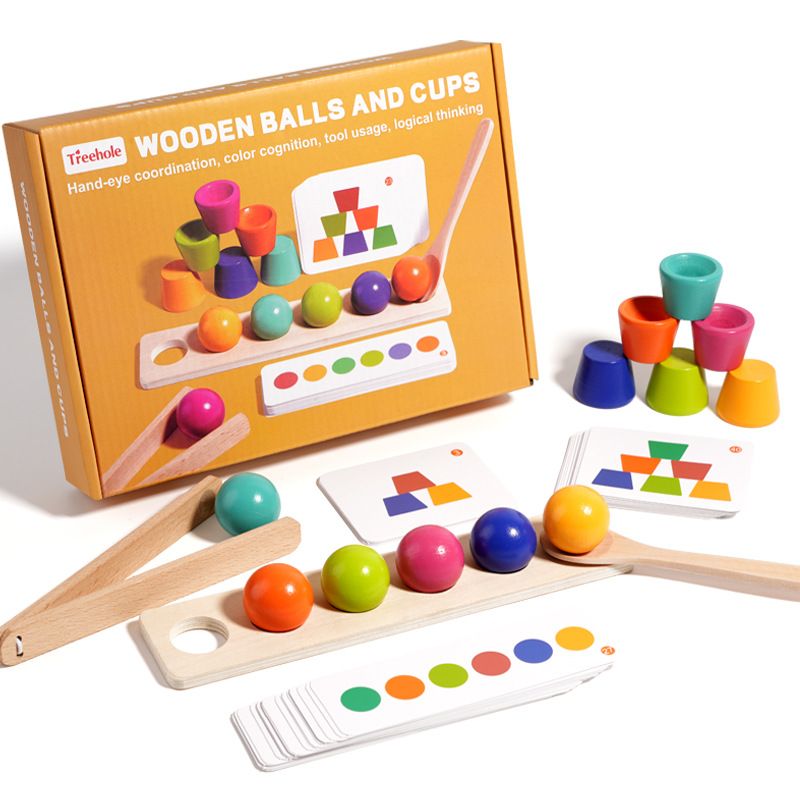
Consider our Montessori Bead Matching Toy. At first glance, it’s a beautiful color-matching activity. But look closer at the work involved.
- The Tool: A child uses a wooden clip, not their fingers. This isn’t an arbitrary choice. Using that clip requires a precise pincer grip—the exact same finger coordination needed to hold a pencil, button a shirt, or use utensils. Every pickup is a micro-exercise in future independence.
- The Task: The goal is clear: place each bead in its matching colored well. The control of error is visual. If a red bead is in the blue spot, it’s obvious.
- The Outcome: A child sits in focused silence, not because they were told to, but because the task is perfectly calibrated to challenge and satisfy them. They are refining fine motor control, visual discrimination, and concentration—all foundational skills for academic and life success—completely on their own.
This is the secret. The Montessori toy isn’t just keeping them busy; it’s building them. And you didn’t have to orchestrate it.
Your Blueprint for an Independent Play Space
Transforming your living room into a haven for independent play is simpler than you think. It’s about strategy, not a full renovation.
- The “Shelfie” is Key: Use a low, accessible shelf. This is your Montessori toy storage solution. It signals that toys are meaningful choices, not clutter.
- Less is infinitely more: Rotate 6-8 toys onto the shelf at a time. An overwhelmed child with too many choices is a child who will say “I’m bored!” and look to you. A curated selection invites deep engagement.
- The Presentation Matters: Place each activity on a tray or in a basket, complete and ready to go. This order subconsciously communicates respect for the work and makes cleanup part of the independent cycle.
- The 3-Step Demonstration: When introducing a new toy, give a slow, silent, and precise demonstration. Show how to carry it, how to use it, and how to return it. Then, hand it over. Your job is done.
FAQ: Your Independence Questions, Answered
Q: If the child plays alone, am I being neglectful?
A: This is a crucial distinction. There’s a world of difference between neglect (leaving a child to flounder with no support) and respectful non-interruption (providing a safe, prepared environment for focused work). You are present and available, but you are allowing the vital space for concentration and self-discovery to grow. You are observing, which is an active form of love and attention.
Q: My child gets frustrated and asks for help immediately. What do I do?
A: Resist the urge to jump in and solve it! Offer the minimum help necessary. You might point quietly to where a piece could go or simply say, “You’re working hard on that.” Often, just your calm presence is enough for them to re-engage. If frustration is high, it’s okay to calmly say, “Let’s put this away and try again later.” The goal is a challenge they can overcome, not a point of distress.
Q: Are these Montessori toys only for “calm” children? What about my energetic kid?
A: Independent play is especially powerful for energetic children. It channels their physical and mental energy into a focused, purposeful outlet. The action of carefully carrying, placing, and manipulating is exactly what their developing system craves—orderly movement. Start with more physical materials and watch as the work itself brings a sense of calm and mastery.
Embracing Montessori toys is, in many ways, a gift to yourself as much as to your child. It’s the permission slip to move from a state of constant “doing” for your child to one of thoughtful “being” with them. It replaces the noise of directive play with the peaceful hum of a child deeply engaged in their own important work.
You are not buying a toy. You are investing in a competent, confident, and independent little human—and reclaiming moments of peace in your own day. The Montessori Bead Matching Toy is more than a color game; it’s a partner in parenting. It’s the quiet, self-sufficient activity that engages your child’s mind and muscles, giving you the space to be a person, not just a playmate.
Stop feeling guilty for not being constantly on the floor. Start setting up for success. Choose Montessori toys that do the teaching, so you can enjoy the witnessing. Explore our Montessori toys collection for self-directed learning and skill-building, designed to inspire independent play.