
Let’s talk about the real goal of play. It’s not just about keeping little hands busy (though that’s a nice perk). It’s about building the architecture of the mind. We all hope our children grow into curious, logical, and confident problem-solvers. But how do you nurture a future engineer, scientist, or creative thinker when they’re still in preschool?
The answer might surprise you. It’s not about early flashcards or drilling numbers. It’s about the deep, foundational cognitive work that happens when a child is utterly absorbed in a simple, hands-on task. This is where authentic Montessori toys shine. They aren’t just toys; they are the concrete, physical precursors to abstract thought. They build the brain’s wiring for logic, spatial reasoning, and systematic thinking—the very bedrock of STEM learning.
Beyond Counting: The Cognitive Foundations

When we think of “early math,” we often jump to counting and number recognition. But long before a child understands that “5” represents a quantity, they need to understand the concepts that numbers describe: order, sequence, dimension, and classification.
These are sensory concepts first. A child must feel what “big” and “small” mean with their hands before they can compare numbers on a page. They must see and create patterns before they can understand equations. This is the genius of the Montessori approach: it makes the abstract tangible. The right wooden educational toy for a preschool child isn’t teaching them to memorize; it’s allowing them to discover and internalize fundamental laws of the physical world.
The Playground of Logic: Key Skills Built Through Play
Let’s break down the critical cognitive skills that the best Montessori toys develop, often without the child even realizing they’re “learning.”
1. Spatial Reasoning & Visualization
This is the ability to mentally manipulate shapes and understand relationships in space. It’s crucial for geometry, engineering, architecture, and even understanding graphs.
- How Montessori Toys Build It: Activities that involve stacking, building, nesting, and fitting objects together force the brain to rotate shapes, predict outcomes, and understand balance.
- The Parent Win: You see your child planning, testing hypotheses (“Will this block fit here?”), and adjusting their approach—the scientific method in its purest form.
2. Seriation & Patterning
This is the understanding of order—arranging objects by a specific attribute like size, length, or shade. It’s the foundation for understanding number sequences, timelines, and logical order.
- How Montessori Toys Build It: Materials that require a child to place items in a specific progression from smallest to largest or to match and create sequences.
- The Parent Win: You observe the development of a methodical, ordered mind. The child begins to perceive and create order from chaos.
3. Classification & Sorting
This is the ability to identify similarities and differences and to group objects by a common characteristic. It’s the basis for data analysis, scientific categorization, and set theory.
- How Montessori Toys Build It: Activities centered on matching colors, shapes, or textures.
- The Parent Win: You see your child’s observational skills sharpen. They start to notice details and make logical connections about their world.
4. Problem-Solving & Trial/Error
The resilience to try, fail, and try again is perhaps the most important skill for any scientist or innovator.
- How Montessori Toys Build It: Materials with a built-in control of error that allow for safe, self-driven experimentation. The child learns that “failure” is just data for their next attempt.
- The Parent Win: You foster intrinsic motivation and grit. The child learns to find satisfaction in the process of solving the puzzle, not just in the end result.
A Case Study in Cognitive Engineering: The Shape Stacking Toy
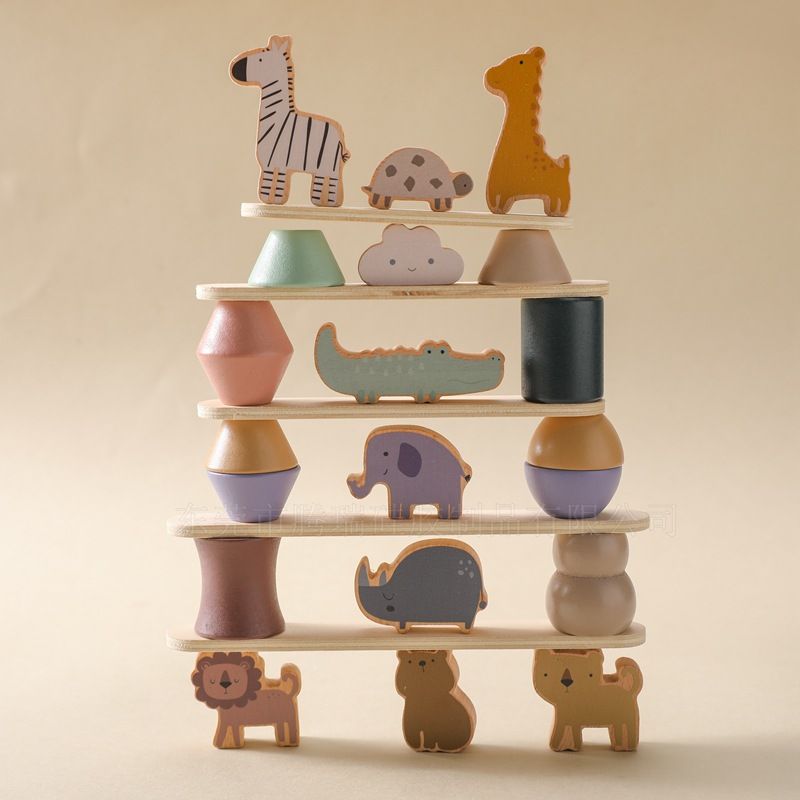
To see all these principles in action, let’s look at a quintessential example: our Montessori Wooden Shape Stacking Toys. At a glance, it’s a charming set of blocks. But under the surface, it’s a powerhouse of cognitive development.
- The Obvious Challenge: Match the shape to the correct pillar. This builds visual discrimination and hand-eye coordination.
- The Deeper Cognitive Work: The true magic begins when the matching is done and the project of building starts. This is where the DIY available nature of the Montessori toy launches a learning laboratory.
- Spatial Reasoning & Physics: Can they build a tall tower? They must consider the center of gravity, the stability of each block, and the law of cause and effect (“If I put the heavy star on top of the narrow rocket, it will tip.”).
- Engineering & Problem-Solving: Their first tower may fall. This isn’t a defeat; it’s the most valuable part of the educational process. They must analyze why it fell and redesign their structure. They are learning foundational principles of engineering through direct experience.
- Patterns & Sequences: With themes like forest or outer space, they can create narrative sequences or color patterns, engaging early mathematical thinking.
- Focus & Persistence: The goal of creating a stable, perhaps complex, structure requires sustained concentration and patience. This deep focus is the state in which the most significant neural connections are formed.
This one wooden educational toy isn’t a single activity; it’s a platform for endless experiments in logic, spatial awareness, and creative problem-solving. It’s the best preschool learning toy precisely because it grows with the child’s mind, offering ever-more complex challenges as their understanding deepens.
The Parent’s Role: Facilitator, Not Instructor
Your job in this process is beautifully simple and profoundly important. You are not the teacher of facts but the curator of experiences.
- Provide the Tools: Choose a few high-quality, open-ended Montessori toys that target these foundational skills. A well-organized shelf with thoughtful Montessori toy storage invites independent exploration.
- Get Out of the Way: After a brief, clear demonstration, resist the urge to direct, correct, or even over-praise. Allow the struggle and the discovery to belong to the child.
- Observe and Appreciate: Watch the gears turn. Notice the moment of frustration followed by the breakthrough. Your quiet presence and trust are more valuable than any instruction.
FAQ: Nurturing Little Thinkers
Q: My child is more artistic than “mathy.” Are these toys still a good fit?
A: Absolutely! This is a critical point. The skills these toys develop—spatial reasoning, pattern recognition, keen observation—are fundamental to art, music, and design just as much as to math and science. An architect needs a strong spatial sense; a musician understands patterns and sequences. You’re not building a narrow “math brain”; you’re building a flexible, capable thinking brain.
Q: Is there a “right” way for my child to play with these toys?
A: For the classic materials, there is usually an intended initial purpose (like matching all the cylinders). However, once that mastery is shown, creative extension is wonderful! Building with the shape stacker, making patterns with the rods, or telling stories with the pieces are all signs of advanced, integrated thinking. The key is that the foundational, skill-building work comes first, providing the mental tools for creative application later.
Q: When will I see the “academic” benefits of this type of play?
A: The benefits are immediate and long-term. Immediately, you see improved concentration, problem-solving persistence, and visual-spatial skills. The academic translation happens organically. A child who has internalized seriation through the Montessori Rod Set will grasp number lines with ease. A child who has honed their fine motor and patterning skills with matching toys will approach writing and early math with more confidence and understanding. You are building the cognitive foundation upon which all formal academic learning will later be constructed.
Investing in genuine Montessori toys is an investment in your child’s fundamental cognitive toolkit. You are providing them with the opportunity to build their own understanding of the logical, ordered, and beautiful patterns that underpin our world. This isn’t about pushing academics down; it’s about solidifying the ground beneath their feet so they can reach higher later, with confidence and joy.
The Montessori Wooden Shape Stacking Toys are more than a plaything. They are a distillation of this philosophy—a simple, beautiful set of tools that unlock complex thinking. They invite your child to be the scientist, the engineer, and the architect of their own learning, one balanced block at a time.
Choose toys that do more than entertain. Choose tools that build the thinkers of tomorrow. Explore Montessori toys for preschool math and science development that strengthen spatial reasoning, problem-solving, and independent learning through hands-on play.